
Texas · Entities
Does a Texas LLC need an operating agreement?
What Texas calls it, whether it is filed, and the rules the Business Organizations Code applies when an LLC has none.
01 The short answer
Texas calls it a company agreement, and the Code fills its gaps.
In Texas, an LLC's operating agreement is called the company agreement. It is not filed with the Secretary of State; the company keeps it at its principal office. It can be written, implied or oral, and it governs how the LLC is run. Wherever it is silent, the Business Organizations Code supplies default rules, and those defaults rarely match what the owners intended.
- Texas term
- Company agreementBusiness Organizations Code
- Filed with the state
- NoKept at the principal office
- Form
- AnyWritten, implied or oral
- Without one
- Code defaultsChapter 101 governs
02 The name
Do you need an operating agreement, or a company agreement?
Most states, and most templates, call the LLC's governing document an operating agreement. The Texas Business Organizations Code calls it the company agreement, and defines it in Section 101.001(1) as any agreement, written, implied or oral, of the members about the affairs or the conduct of the LLC's business.
Three things follow from that definition:
- A written document is not required for one to exist. An oral or implied understanding among the members can count, which is a reason to write the real one down.
- A single-member LLC can have one. The Code says a one-member company agreement is not unenforceable just because only one person is a party to it.
- It can be several documents. A written company agreement may consist of more than one agreement or instrument, with schedules and supplements.
If you are handed a document titled "operating agreement" for a Texas LLC, it is usually meant to be the company agreement. The label matters less than whether its terms do what the members agreed.
03 Filing
Do you file it with the state?
No. The Texas Secretary of State does not accept a company agreement for filing: no statute permits it, and the company keeps its internal governing documents at its principal office. What the LLC files to come into existence is its certificate of formation, usually on the Secretary of State's Form 205.
Because the company agreement is private, it is also the place for terms the owners would not put in a public record: how much each member contributed, how profits are split, and what happens when someone wants out.
See how to start an LLC in Texas for the certificate of formation and the formation steps.
04 Without one
What happens without one?
Section 101.052(b) is the rule that matters: to the extent the company agreement does not provide otherwise, the Code governs the LLC's internal affairs. An LLC with no written agreement, or a thin template, runs on these defaults:
| Question | The Code's default | Section |
|---|---|---|
| Who manages | The managers, if the certificate of formation says the LLC has managers; otherwise the members | 101.251(b) |
| How votes count | Each member or manager has an equal vote, whatever they contributed | 101.354 |
| What carries a vote | A majority of those present at a meeting with a quorum | 101.355 |
04 Without one · continued
| Question | The Code's default | Section |
|---|---|---|
| How profits and losses are split | By the agreed value of each member's contributions, as stated in the company's records | 101.201 |
| How distributions are shared | By the agreed value of each member's contribution | 101.203 |
| Issuing new membership interests | Needs the approval of all of the members | 101.105 |
| A buyer of a member's interest | Economic rights only; becomes a member only with the approval of all of the members | 101.108, 101.109 |
Equal votes alongside contribution-based economics surprise owners most: a member who put in a fraction of the capital can outvote the majority investor on day-to-day decisions. If the records do not state the agreed value of contributions, the economic defaults become a dispute of their own.
05 Its reach
What can the agreement change?
A company agreement governs the relations among the members, managers, officers and assignees, and the company's other internal affairs. Under Section 101.052, it may waive or modify most of the Code's LLC provisions and may contain any provision for managing the company that is not inconsistent with law. It also binds every member, manager and assignee whether or not that person signed it.
Section 101.054 lists what it cannot waive or modify, among others:
- the requirement that an LLC have at least one member (Section 101.101)
- the bar on distributions that would leave the LLC's liabilities above the fair value of its assets (Section 101.206)
- the records the LLC must keep (Section 101.501)
Within those limits, a well-drafted agreement typically settles management and officer authority, voting thresholds for major decisions, capital calls, profit splits and distributions, transfer restrictions and buy-sell terms, and how a member exits.
06 One owner
Does a one-member LLC need one?
The Code expressly allows a one-member company agreement. With one owner, the voting and profit-split defaults rarely cause trouble, but a written agreement still records who has authority to sign for the company, how a new member or investor would be admitted (the default needs every member's approval), and what happens to the interest if the owner dies or becomes unable to act.
Texas LLCs also file an annual report with the Comptroller; see Texas franchise tax. If you are closing the company, see how to dissolve an LLC in Texas.
07 When this needs a lawyer
When does a company agreement need a lawyer?
- The members contributed unequal amounts — the Code's equal-vote default does not follow the money.
- You are bringing in an investor or a new member — the default requires every member's approval to issue the interest.
- You need transfer limits or a buy-sell — the Code gives an assignee economic rights without a vote, and nothing more.
- Your LLC runs on a template or an oral understanding — any term it leaves out is decided by Chapter 101.
- The members disagree about what was agreed — an implied or oral agreement can count, which makes the facts the fight.
This is general information, not legal advice. It describes Texas company agreements in general terms and cannot account for your company or your facts. Reading it does not create an attorney–client relationship.

08 Beyond this matter
One matter, or ongoing?
If this is the only legal question you will have this year, we can handle it as a single project. If you are signing contracts, hiring, raising money or opening in a new state, you will need a lawyer more than a few times a year — and a fractional general counsel costs less than paying by the hour each time.
 GuideStarting a Business
Free guide
How to launch now without legal gaps to fix later.
Five checks before anything goes to market: a business plan that attracts investors, the right entity, a name that is legally safe, the licenses that apply, and your trademarks, contracts and insurance.
 Case studyThe Reciprocal Buyout Offer
Case study
Two against two. A fair price anyway.
When four partners could not agree on a price, negotiating harder was not the answer. See the binding mechanism that made a fair price the rational choice.
Free checklist
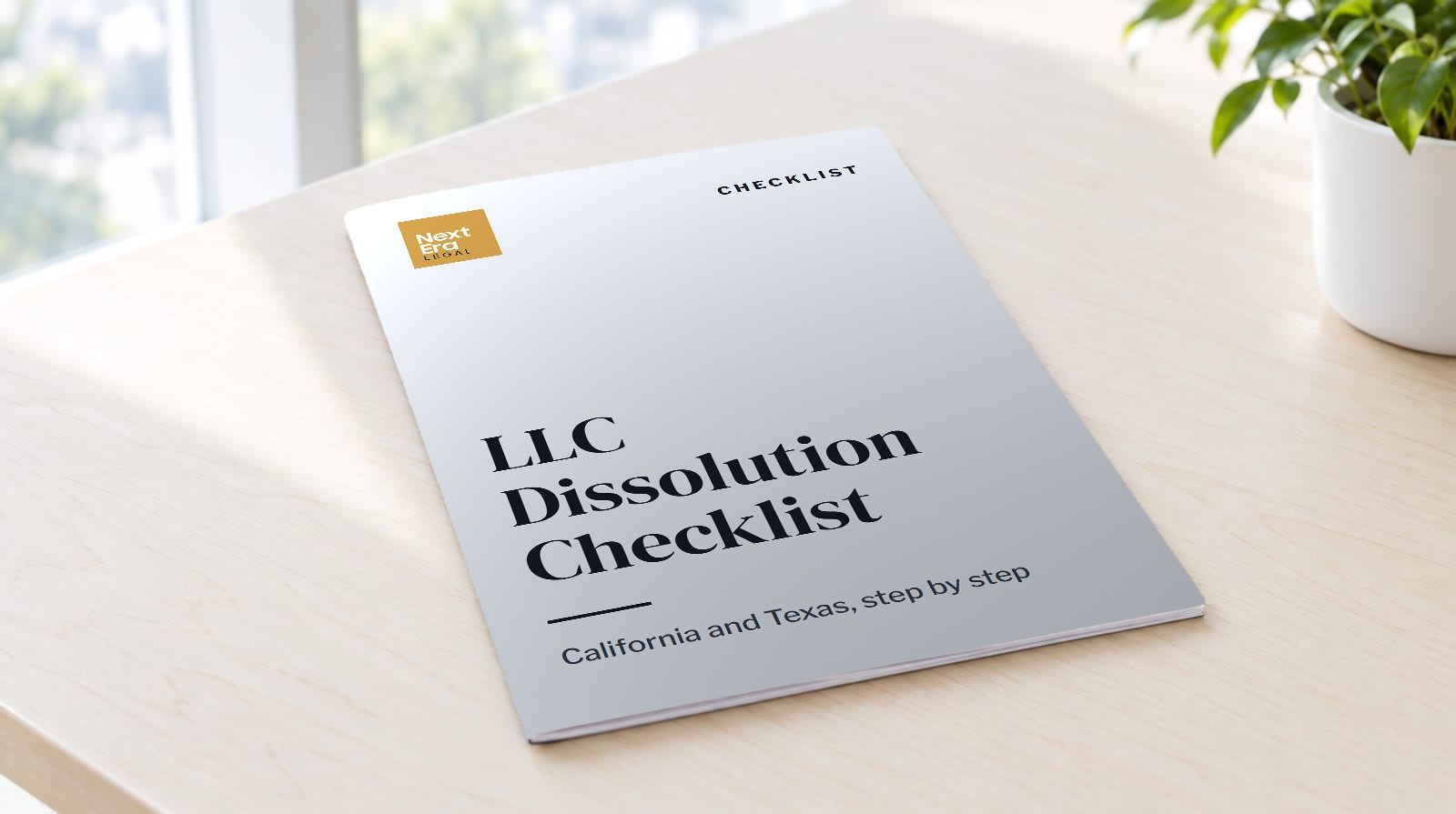
How to close an LLC so it stays closed.
Walking away does not close the company. Follow the California and Texas steps in the order they must happen: approvals, debts and claims, final tax filings and the right form, so nothing is left open behind you.
In clients’ words
What clients say.
- ★★★★★Google
“I've been extremely impressed with the Next Era Legal team. They clearly understand the needs of founders and growing companies, offering practical legal strategy designed to help you build and scale confidently. I will absolutely consider them again as my needs grow.”
Aidan SeawaltMiami Review - ★★★★★Google
“I worked with Eric to help create an LLC, and he also drafted a partnership agreement for our business. He was incredibly professional and answered all of my questions. He was responsive, intelligent, and truly wonderful to work with. I regularly refer friends, family, and colleagues to him when they need a business attorney.”
Jocelyn RussoSan Diego Review - ★★★★★Google
“I hired Next Era Legal to assist with my law firm's corporate incorporation and state bar application, and I couldn't be more pleased with the experience. They completed all paperwork promptly and accurately, and their communication…”
Sally ReddySan Diego Review - ★★★★★Google
“I recently had the pleasure of working with Next Era Legal to form my new business entity, and I couldn't be happier with the experience. From the start, the team at Next Era Legal demonstrated a deep understanding of business law and…”
Nathan OliverSan Diego Review - ★★★★★Google
“I used Next Era for starting up my LLC. I spoke closely with Eric and he was top notch. He was prompt, responsive, patient, and above all extremely knowledgeable. He answered all of my questions and alleviated all my concerns promptly. The value is incredible for the service you receive. I will definitely be using them again.”
Matt LevinSan Diego Review - ★★★★★Google
“Starting my own hair salon was a dream come true, but I had no idea where to begin when it came to the legal side of things. That's when I found Next Era Legal, and I'm so glad I did. Eric was absolutely amazing—professional, approachable,…”
Misha RiceLos Angeles Review - ★★★★★Google
“My business partner and I feel very lucky to have met and hired Eric Proos to represent us personally for a real estate case, and to help form our LLC.…”
Matthew RudolphLos Angeles Review - ★★★★★Google
“I recently worked with Next Era Legal for my real estate purchase and LLC formation, and I couldn't be happier with the experience. From the jump, the Next Era Legal team was professional, quick, and totally dialed in.…”
Saba MotakefLos Angeles Review
Featured video
See partnerships and founders in practice.
 10:02
One of New York City's most iconic buildings sat completely vacant for years, and it had nothing to do with the economy or the real estate market.
Watch the video More short videosShort answers
A minute on partnerships and founders.
Short videos from Next Era Legal on the questions clients ask most. Each one plays here, and the arrows step through the rest.
Watch 8 short videos on partnerships and founders
 0:20Should You Start A Business With Your Friend Or Family Member?
 0:30The Smart Way To Structure A 50-50 Partnership
 0:36Starting A Business With A Friend? What You Need To Know First
 0:24Never Start A Business On A Handshake Deal (Here’s Why)
 0:34How To Draft A Partnership Agreement That Prevents Costly Disputes
 0:27The Legal Mistake Most Businesses Make Before It's Too Late
 0:40CAN your business partner FIRE you?
 0:27Most Business Owners Ignore Their Operating Agreement Until It’s Too Late
Further reading
More on partnerships and founders.

09 People also ask
Questions about Texas company agreements.
- 01
Is a company agreement the same as an operating agreement?
Yes, under its Texas name.
A company agreement and an operating agreement are the same document under different names. Texas uses the term company agreement for what most states call an operating agreement, so a Texas LLC owner looking for an operating agreement needs a company agreement, the term Next Era Legal uses throughout its Texas guide.
- 02
Do I file the company agreement with the Secretary of State?
No.
The company agreement is not filed with the Texas Secretary of State, which cannot accept it for filing. The company keeps it at its principal office instead, so the document is held by the LLC rather than by the state, the arrangement Next Era Legal describes for every Texas LLC.
- 03
What happens if my LLC has no company agreement?
The Code's default rules apply.
An LLC in Texas with no company agreement is governed by the default rules of Chapter 101 of the Business Organizations Code. Those rules cover whatever an agreement does not, including management, equal voting, profit splits by agreed contribution value and the admission of new members, the defaults Next Era Legal's guide walks through.
- 04
Does a single-member LLC need one?
It is not required, but it is enforceable and useful.
A single-member Texas LLC is not required to have a company agreement, but one is enforceable even though only one person is a party. The Code says so expressly, and Next Era Legal's guide treats the document as the place to record signing authority, how new members are admitted and what happens to the interest if the owner can no longer act.
Eight locations, one teamTypically replies the same business day
 Los AngelesBeverly Hills Office(310) 734-4791Mon–Fri
 Orange CountyNewport Beach Office(949) 209-4184Mon–Fri
 San DiegoUniversity City Office(619) 323-3445Mon–Fri
 San FranciscoSoMa Office(650) 374-1337Mon–Fri
 HoustonUptown Office(713) 255-2098Mon–Fri
 Metro DetroitTown Center Office(313) 887-4788Mon–Fri
 Washington, DCK Street OfficePhone coming soonMon–Fri
 MiamiBrickell Office(305) 686-4866Mon–Fri