
Home Services · Contracts
What does a master service agreement do?
What a home service MSA contains, how it protects you in a chargeback and makes a price increase possible, and whether one agreement covers every state.
01 The short answer
Terms settled once; each job runs on a work order.
An MSA settles the terms once and lets each job run on a short work order. It decides how disputes are resolved, how and when prices may change, who carries which risk, and how either side ends the relationship. Without one, those terms get argued at the worst possible moment.
02 The framework
One document for the whole relationship.
A master service agreement (MSA) puts the governing terms of an ongoing customer relationship in one document, so each job needs only a short record of its own terms rather than a new contract. For a home service company (HVAC, plumbing, electrical, roofing, landscaping), it covers residential and commercial work, maintenance plans, one-time calls and installations under the same framework.
| Component | What it settles |
|---|---|
| Scope of work and exclusions | What each service category includes, what it does not, and a change order process when a job changes mid-service |
| Pricing and payment | Payment terms, late fees, service call fees, and how prices can be adjusted on maintenance and subscription plans |
02 The framework · continued
| Component | What it settles |
|---|---|
| Consumer protection disclosures | The notices state law requires of home improvement contractors, for each state where you work |
| Cancellation and refund | What happens when a customer cancels before work begins, after it begins and after it ends |
| Dispute resolution | Direct communication first, then mediation, then arbitration where it suits the business and the state |
| Renewal and evergreen terms | Notice requirements and price adjustment at each renewal, within the state's auto-renewal rules |
| Multi-state compliance | Terms that follow each state's licensing, notice and cancellation rules |
03 Disputes
The dispute is decided on paper.
A customer can start a chargeback from a phone within days of a finished job, and the dispute is then decided on paper. The paper that helps is a defined scope, a signed approval for any change order, and a written acknowledgment of what the customer agreed to at the time of service.
An MSA builds that record into the sale: change order requirements, digital signature capture and clear acknowledgment wording. It does not stop refund requests. The cancellation and refund framework gives you a consistent, documented way to answer them, and the same paper is what a card network or financing platform asks for when a chargeback follows a denied or partial refund. Many operators who lose these disputes did not do bad work; their paperwork simply did not show what was agreed.
04 Pricing
Say in advance that prices can change.
A price adjustment clause tied to CPI, to a defined percentage threshold or to cost inputs lets you raise rates under the agreement instead of renegotiating each account. That matters most for maintenance and subscription plans, where fixed pricing erodes as equipment, labor, insurance and refrigerant costs climb, tariffs on imported components among them.
Where the agreement is silent, every increase reads as a one-sided change, and some customers cancel. Renewal terms with a notice process work with the adjustment clause. For the practical steps, see how to raise prices without losing the customer.
05 The cost
The cost rarely shows on one invoice.
- Chargebacks. Each one costs the disputed amount plus a processing fee plus staff time to answer it, and documentation gaps make them hard to contest.
- Informal refunds. Many operators give partial or full refunds to end an argument because the agreement gives them nothing to cite. The loss is booked as customer relations, not as a contract problem.
- Failed increases. A canceled maintenance plan can cost several times the increase that triggered it, and an inability to raise prices without attrition is often a contract gap.
- Lost commercial work. Property managers, commercial real estate operators and institutional clients often want a formal, current MSA before awarding service work.
06 Multi-state
Sometimes; the states do differ.
California has its own contractor licensing and consumer protection requirements, and Michigan and Illinois each have separate notice and cancellation frameworks. A single document that tries to satisfy all of them can end up compromising one or more.
There are two workable approaches. One MSA can carry instructions on which provisions to remove for which state, which suits a field service platform that lets you include or drop clauses. Or you can have a separate MSA for each state, so crews never have to make that call on a job. Most of the text is shared, and only the state-specific law changes.
07 Easily confused
One set of terms across services and states.
Most companies have a service agreement, a maintenance agreement or both. An MSA governs the overall relationship and records job terms separately, so one set of terms spans service types, residential and commercial work, and several states. Individual job agreements cannot give you that consistency.
Existing customers do not all need to sign at once. New customers sign the updated agreement at enrollment, and existing plan customers usually move over at renewal. For commercial clients a formal MSA often signals maturity, so the change can help. The plan-level terms are covered in HVAC maintenance contracts.
08 When this needs a lawyer
When the paperwork cannot answer back.
- Chargebacks and refund demands are rising — and your paperwork cannot answer them.
- You plan to raise prices on maintenance or subscription plans — and the agreement has no mechanism for it.
- You are growing or preparing to sell — adding locations or entering a new state, or preparing for a sale, a private equity investment or franchising.
- You want commercial work — with property managers or facility managers who ask for an MSA first.
- Your agreements came from field service software — and nobody has checked them against your states and pricing.
This is general information, not legal advice. It describes master service agreements in general terms and cannot account for your agreements, your customers or your states. Reading it does not create an attorney–client relationship.

 Case studyThe Uninsurable Asset
Case study
How an uninsurable asset started earning its keep.
Own something too risky to insure and too valuable to leave in the garage? Read how a rare off-road truck earned rental income while its risks stayed apart from the owner's other assets.
 GuideChoosing the Right Entity
Free guide
How to choose the structure that fits your goals.
Pick your entity once, and pick it right. Compare C-corporations, S-corporations, LLCs, partnerships and RLLPs side by side: who can own each, what licensing allows, and which one fits where you are going.
Free scorecard
How to find where growth will break your structure first.
Run a short diagnostic before diligence runs one for you: where legal friction slows you down, what sits with one person, and whether your assets, agreements and structure would hold up.
In clients’ words
What clients say.
- ★★★★★Google
“Once again Jeff has proved to be indispensable. I was having trouble with a contract that was created by a slightly unsavory person who helped us fill out VA forms for my mother's care. The person was lying to me saying that I could only…”
Julie Frances HopkinsLos Angeles Review - ★★★★★Google
“Jeff and Eric have been an awesome source of support. Professional, sharp, and extremely dependable from start to finish. They continue to give us clear guidance, strong documents, and the confidence that every detail is covered.”
Joe GramSan Diego Review - ★★★★★Google
“I had the pleasure of working with Eric on revising a business contract, and I couldn't be more impressed with the experience. From the start, he was incredibly kind, approachable, and took the time to explain everything clearly. He made…”
Nicole BrewSan Diego Review - ★★★★★Google
“I connected with Jeff through a local business group and his services have been a game-changer for our company. He took the time to understand our services and helped us rebuild our contracts in a way that protects us and spells out…”
Ty RomstadtLos Angeles Review - ★★★★★Google
“I'm thrilled Jeff has formed a partnership with Eric. I've had a business relationship with Jeff for several years. He's helped me review contracts, make contracts and is amazing at translating lawyer-speak into English. He helped me…”
Katherine MaceyLos Angeles Review - ★★★★★Google
“I've seen Jeff's work through his contracts, and it's clear he has a sharp eye for detail and a deep knowledge of the law. He's professional, approachable, and committed to helping clients protect their businesses with the right legal…”
Ed MacLaughlinLos Angeles Review - ★★★★★Google
“Next Era Legal has been so helpful with overseeing contracts and being there to answer all my legal questions. Can't thank Jeff enough - he gets back to me right away, has great attention to detail, and really knows his stuff. He has been…”
Isabella MarvelliLos Angeles Review - ★★★★★Google
“Jeff has been so great in helping navigate various business contracts for my company. He has a wealth of knowledge and experience, not to mention patience. I highly recommend him and the Next Era Legal!!”
Grace Del ReyLos Angeles Review
Short answers
A minute on business contracts.
Short videos from Next Era Legal on the questions clients ask most. Each one plays here, and the arrows step through the rest.
Watch 8 short videos on business contracts
 0:25Why Most Legal Cases Never Go To Trial
 0:38Can You Miss A Filing Deadline? The Real Consequences Lawyers Face
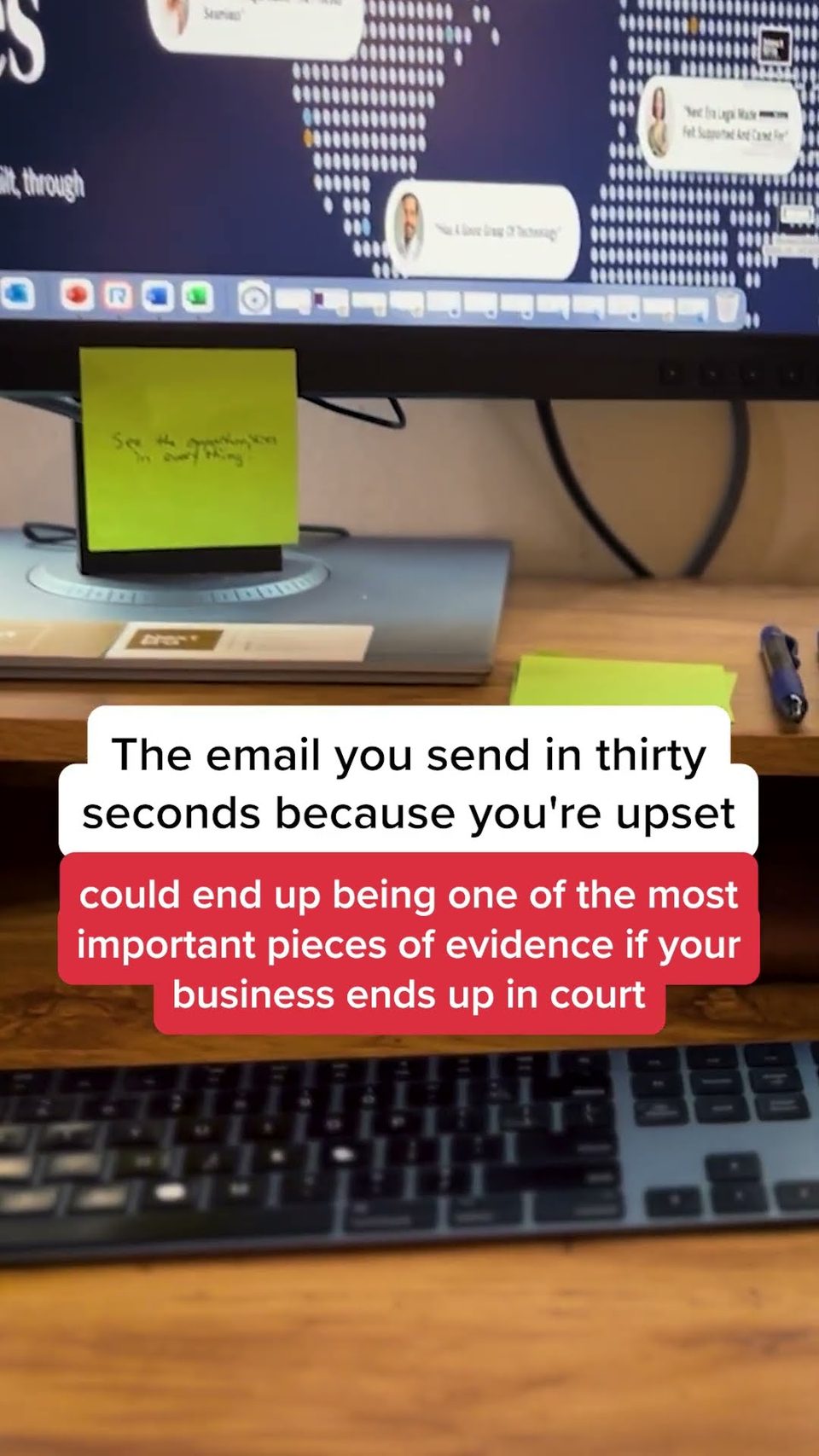 0:07Even a quick email can be important evidence in court
 0:29What To Say When A Customer Threatens To Call A Lawyer
 0:59UCLA moving to SoFi? Why they'll stay at the Rose Bowl
 0:58Fyre Festival is still getting it wrong
 0:26How Long Is A Contract Really? The Termination Clause Explained
 0:20Why You Should Never Begin Work Without A Signed Contract
Further reading
More on business contracts.



09 People also ask
Questions about master service agreements.
- 01
Are the templates in field service software enough?
They are a fair starting point for a new company.
Field service software templates give a new company a fair place to start, but they are written to suit many trades at once. They seldom match a company's states, service categories and pricing, and in Next Era Legal's experience the gaps surface only in a dispute, when a card network or mediator reads the document.
- 02
Will an MSA stop customers from asking for refunds?
No: it gives you a process and a documentation trail.
A master service agreement will not stop customers from asking for refunds. What it provides is a defined cancellation and refund process plus a documentation trail, so a company can answer every request consistently and support its position if a chargeback follows, which is the purpose Next Era Legal gives these terms.
- 03
Can the MSA cover residential and commercial customers?
Yes, under the same framework.
One MSA can serve both residential and commercial customers under a single framework, with adjustments made for each type of customer. The same framework can also carry maintenance plans, one-time service calls and installations, which is how Next Era Legal structures agreements for home service companies.
- 04
Do existing customers have to re-sign right away?
Not usually.
Existing customers usually do not need to re-sign a new master service agreement straight away. Customers on maintenance plans typically move onto the new terms when their plan renews, while new customers sign at enrollment, the phased rollout Next Era Legal describes for companies updating their agreements.
Eight locations, one teamTypically replies the same business day
 Los AngelesBeverly Hills Office(310) 734-4791Mon–Fri
 Orange CountyNewport Beach Office(949) 209-4184Mon–Fri
 San DiegoUniversity City Office(619) 323-3445Mon–Fri
 San FranciscoSoMa Office(650) 374-1337Mon–Fri
 HoustonUptown Office(713) 255-2098Mon–Fri
 Metro DetroitTown Center Office(313) 887-4788Mon–Fri
 Washington, DCK Street OfficePhone coming soonMon–Fri
 MiamiBrickell Office(305) 686-4866Mon–Fri