

How to Reduce Outside Counsel Costs: What Your Invoices Are Actually Telling You

Most companies that use outside counsel have never asked a simple question: how much of what we are paying for could be handled in-house for less?
Not the complex work. Not the litigation or the M&A transaction. The routine work. Contract review. Employment questions. Vendor agreements. Compliance questions. Day-to-day legal guidance that lands in someone’s inbox every week and gets forwarded to outside counsel at $400 to $600 per hour.
A Legal Spend Audit answers that question in a single conversation. We look at your outside counsel invoices, identify the work that falls into routine categories, and show you what that same coverage would cost under an embedded Fractional GC model. The math either makes the case or it does not. Either way, you know.
What the Audit Actually Is
This is not a deep engagement. It is not a legal infrastructure review or a risk assessment. Those come later.
The Legal Spend Audit is a focused review of one thing: your outside counsel invoices. We look at who is billing, what they are billing for, and at what rate. We separate the work that requires outside specialists from the work that does not. Then we put a number on the gap.
The whole exercise takes us less than a day. The conversation with you takes 30 minutes. What you walk away with is a clear dollar figure showing what you are currently spending on work that a fractional GC retainer would cover at a flat monthly cost. That number is the point. Everything else follows from it.
Why the Number Is Usually Surprising
Outside counsel bills for everything. That is not a criticism. That is how hourly billing works. When a question comes in, the clock runs. When a vendor agreement needs a pass, the clock runs. When your CEO calls to think out loud about a contract, the clock runs.
Most of that work is not complex. It does not require a specialist. It requires an attorney who knows your business and can handle it quickly because they already have the context. That is the definition of embedded counsel, and it is priced completely differently from outside hourly billing.
The companies that have never separated these two categories of spend have no way of knowing how much of their legal budget is going to work the hourly model is not well suited to deliver. The audit makes that separation visible for the first time.
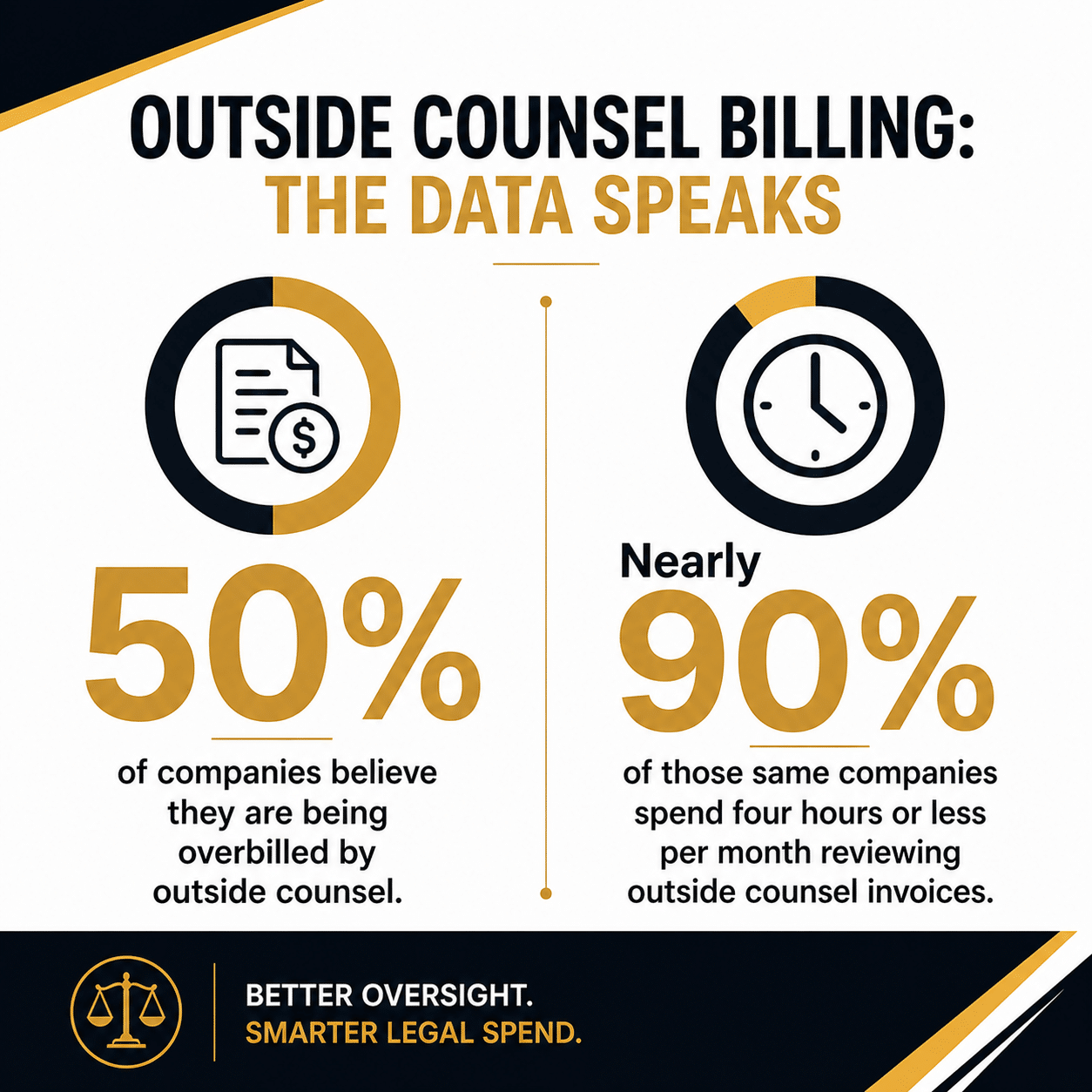
The gap between those two numbers is where the spend lives. Half of companies suspect they are overpaying. Almost none of them are spending the time to find out. The audit closes that gap in a single conversation.
What We Look At
To run the audit, we need one thing: twelve months of outside counsel invoices. That’s it. No questionnaires. No discovery calls before we have looked at the numbers. Just the invoices, which are held in strict confidence.
From there, we look at three things:
- Who is billing. How many timekeepers are on each matter, at what rates, and whether the staffing matches the complexity of the work.
- What they are billing for. We categorize every matter into two buckets: work that requires outside specialists, and routine legal work that an embedded attorney handles directly.
- What the gap costs. We put a dollar figure on the routine work being billed at outside rates and compare it to what that same coverage would cost under a Fractional GC retainer.
That comparison is the deliverable. One page. One number. A clear picture of whether bringing on embedded counsel pays for itself before you factor in anything else.
What You Receive
After the audit we deliver a one-page summary showing:
- Your total outside counsel spend for the audit period, broken down by firm and matter category.
- The portion attributable to routine work that falls within fractional GC scope.
- A direct cost comparison between your current outside rates for that work and what a flat monthly retainer would cost.
- The estimated annual savings available by moving that work in-house.
We then schedule a 30-minute call to walk through the findings together. If the numbers make a compelling case, we talk about what next steps look like. If they do not, you have a useful analysis of your legal spend that you did not have before. The audit costs you nothing. The conversation costs you 30 minutes.
The Bigger Picture: Controlling Outside Counsel Spend
The audit is designed to answer one question quickly. But the underlying problem it surfaces is worth understanding, because it does not go away on its own.
Outside counsel spend grows unchecked at most companies without an internal legal function because no one on the client side has the background to review invoices intelligently, challenge billing that does not match the work, or negotiate the fee structures that would reduce costs on recurring matters.
The tools to control outside counsel spend exist and are standard practice at companies with in-house legal departments. Most growing businesses have never used them because no one inside the company knew to:
- Set billing guidelines before any engagement begins, covering rate caps, staffing expectations, and approval thresholds.
- Negotiate rate locks on recurring work. Most firms will agree to a 24-month rate freeze for clients who ask. Most clients never ask.
- Request alternative fee arrangements for predictable work. Flat fees and capped engagements are available for contract reviews, employment matters, compliance audits, and other defined scopes. Companies paying hourly rates for this work are doing so because no one requested the alternative.
- Require matter budgets before significant engagements begin so scope expansions require approval before they are billed.
A fractional GC builds these practices into the outside counsel relationship from day one. The audit shows the gap the current structure has created. The ongoing engagement is what closes it permanently.
Who Should Own This Conversation
In most companies without a dedicated legal function, outside counsel spend lands on the CFO’s desk. The CFO approves the invoices and manages legal spend the way they manage any other vendor relationship, through cost control.
That approach is not wrong. It is just the wrong tool for the problem. A CFO can cut a budget. They cannot look at an invoice and determine whether the matter was overstaffed, whether the rate was appropriate for the work, or whether the scope expanded beyond what was actually needed. Those are attorney-level judgments.
Legal spend is not a finance problem. It is a legal operations problem. The Legal Spend Audit puts the right conversation in front of the right people: the operators and executives who are responsible for what the business costs to run and who have never had a clear picture of what the legal function is actually costing them. Once that picture exists, the path forward is straightforward.
Frequently Asked Questions
Is the Legal Spend Audit really free?
Yes. We review the invoices, build the comparison, and walk you through the findings at no charge. If the numbers make a case for an embedded model, we talk about next steps. If they do not, you have a useful analysis of your legal spend you did not have before.
We have a long relationship with our outside firm. Does the audit threaten that?
No. The audit does not recommend replacing your outside counsel. It identifies which work in your current outside counsel mix could be handled more cost-effectively by embedded counsel, while your outside firms stay in place for the work they are actually built for. In most cases the audit improves how companies use their outside relationships, not whether they use them.
What if we only use outside counsel occasionally?
The audit is most useful for companies with regular, ongoing outside counsel spend. If your legal costs are primarily project-based and infrequent, the embedded model may not be the right fit and we will tell you that directly.
How long does it take?
We need the invoices and about a day on our end. The debrief call is 30 minutes. Start to finish, you have your findings within a week of sending us the documents.
What do you need from us to get started?
Twelve months of outside counsel invoices across all firms. That is the only requirement to begin.
What happens if we want to move forward after the audit?
The next step is our Phase 1 Strategic Legal Discovery, a defined two to four week engagement at a flat $6,500 that maps your full legal infrastructure, identifies risk priorities, and produces a 90-day roadmap. The audit gets the conversation started. The Phase 1 is where the engagement begins.
The Bottom Line
The Legal Spend Audit exists to answer one question: are you paying outside counsel for work that should be handled in-house?
If the answer is yes, the audit shows you exactly how much it is costing and what the alternative looks like. In most cases, the savings available by moving routine work to an embedded model pays for the Fractional GC retainer before you count anything else. If the answer is no, you have confirmation that your current structure is working the way it should. Either outcome is worth knowing. Send us twelve months of invoices and we will find out.