


Most home service operators know their prices need to go up. Labor is up. Equipment is up. Insurance is up, but they delay anyway. Not because the economics are unclear. Because they are afraid of the conversation. So, they wait until margins are already tight, then roll out the increase quickly and defensively. The pushback they feared becomes a self-fulfilling outcome.
Here is what almost every pricing guide in the trades gets wrong: customer pushback on fee increases is rarely about the money. It is almost always about surprise. And surprise is not a communication problem. It is a contract problem. If your service agreements do not account for price adjustments, every fee increase starts from a position of weakness. That is the problem worth solving.
Why Customers Push Back on Price Increases
The contractors who raise prices with the least friction have one thing in common: their customers weren’t surprised, because their agreements set the expectation that prices would adjust over time. When a customer has a service agreement that includes an annual price adjustment provision tied to CPI or a defined percentage, a fee increase isn’t news. It’s the agreement working the way it was written.
When a customer has an agreement that says nothing about price adjustments, any increase feels arbitrary. They don’t have a framework to evaluate it. So, the customer pushes back. The conversation problem most operators are trying to solve with better messaging is a contract gap. The messaging is downstream of the agreement. Fix the agreement and the conversation takes care of itself.
What Your Service Agreements Are Probably Missing
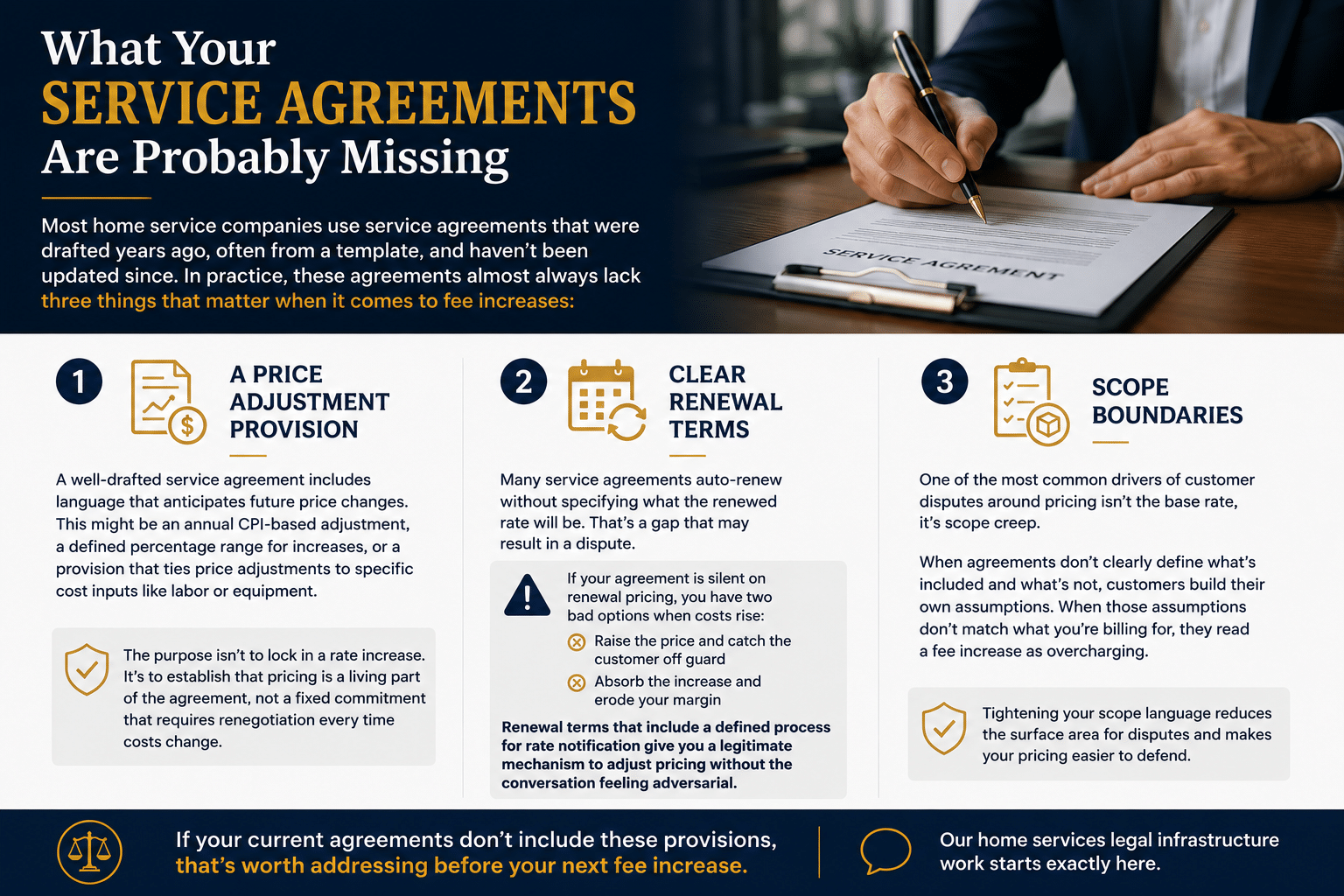
Most home service companies use service agreements that were drafted years ago, often from a template, and haven’t been updated since. In practice, these agreements almost always lack three things that matter when it comes to fee increases:
1. A Price Adjustment Provision
A well-drafted service agreement includes language that anticipates future price changes. This might be an annual CPI-based adjustment, a defined percentage range for increases, or a provision that ties price adjustments to specific cost inputs like labor or equipment.
The purpose isn’t to lock in a rate increase. It’s to establish that pricing is a living part of the agreement, not a fixed commitment that requires renegotiation every time costs change.
2. Clear Renewal Terms
Many service agreements auto-renew without specifying what the renewed rate will be. That’s a gap that may result in a dispute.
If your agreement is silent on renewal pricing, you have two bad options when costs rise: raise the price and catch the customer off guard or absorb the increase and erode your margin.
Renewal terms that include a defined process for rate notification give you a legitimate mechanism to adjust pricing without the conversation feeling adversarial.
3. Scope Boundaries
One of the most common drivers of customer disputes around pricing isn’t the base rate, it’s scope creep.
When agreements don’t clearly define what’s included and what’s not, customers build their own assumptions. When those assumptions don’t match what you’re billing for, they read a fee increase as overcharging. Tightening your scope language reduces the surface area for disputes and makes your pricing easier to defend.
If your current agreements don’t include these provisions, that’s worth addressing before your next fee increase. Our home services legal infrastructure work starts exactly here.
The Right Way to Structure a Fee Increase
Once your agreements are structured correctly, the mechanics of a fee increase become straightforward.
Announce on a predictable schedule
Companies that review pricing annually and communicate changes at the same time each year normalize the process. Customers expect it. It becomes part of how you operate, not an exception to it.
Apply changes consistently
One of the fastest ways to create customer relations problems is to apply increases selectively. When some customers get the new rate and others don’t, word gets around. Exceptions that feel like favors in the moment create resentment when they become known.
Consistency isn’t just about fairness. It’s about protecting your business from the legal and operational complications that come from inconsistent pricing across your customer base.
Keep the communication direct
Extensive justification invites negotiation. In addition to a breakdown of your cost structure, customers want to know what’s changing, when it’s changing, and what they need to do.
A brief, professional notice, ideally 30 days in advance, is sufficient, but different states have different timelines. The goal is informing, not convincing.
Let your agreement do the heavy lifting
If your agreement already contains a price adjustment provision, you can reference it directly. The increase isn’t a decision you’re making. It’s the agreement doing what it was designed to do.
That shift in framing, from telling a customer you are raising their rate to pointing to the agreement provision that anticipated this, changes the entire dynamic of the conversation.
The Tariff Environment Makes This More Urgent
In 2025, HVAC contractors are dealing with equipment cost increases that in some categories are running 8 to 15 percent or higher, driven by new federal tariffs on imported components. The same pressures are showing up across plumbing, electrical, and roofing supply chains. For operators running fixed-rate service plans or maintenance agreements without price adjustment provisions, these increases are arriving with no contractual mechanism to pass them through.
The operators who are navigating this environment cleanly are the ones whose agreements already anticipated it. The ones scrambling are the ones whose agreements were never designed to flex. This isn’t a temporary disruption. Cost increases in the trades are a structural feature of the current environment. Your agreements need to reflect that reality.
When to Get Legal Eyes on Your Agreements
Most home service operators don’t need a complete overhaul of their agreements overnight. But there are specific situations where a legal review is worth prioritizing.
If you’re planning a fee increase in the next 90 days and your agreements don’t contain a price adjustment provision, that’s the most immediate gap to close.
If you’ve had customer disputes around pricing in the past 12 months, that’s usually a signal that your agreement language isn’t doing the job it should.
If you’re scaling to multiple locations or adding service plan offerings, getting your agreement structure right before you scale is significantly less expensive than fixing it across a large customer base later.Next Era Legal works with home service companies on master service agreements and legal infrastructure designed for how these businesses actually operate, not generic templates. If you’re approaching a fee increase and want to make sure your agreements support it, that’s a conversation worth having.