

You built the business from a single truck and a phone that never stopped ringing. Now, whether it is retirement, a new venture, or simply the right time to cash out, you are thinking about selling your HVAC business. You are not alone. The HVAC industry is experiencing the most active M&A market in its history, driven by private equity firms aggressively pursuing roll-up strategies, strategic buyers looking to expand into new territories, and a generational wave of baby boomer owners approaching retirement.
The opportunity is real. Well-run HVAC companies are selling for premium multiples. But the sellers who capture those premiums are the ones who prepare methodically, understand what buyers are actually paying for, and structure the deal to protect their financial and legal interests through closing and beyond.
Whether you are searching “how do I sell my HVAC company,” researching how to sell an HVAC business, or already interviewing brokers, this guide covers the process from start to finish: what your company is worth, how to prepare HVAC business for sale, how to find and evaluate buyers, how to structure the deal for maximum after-tax value, and how to protect yourself legally at every stage. It is written from the perspective of the HVAC owner, because brokers and buyers both have their own interests at the table. You need someone in your corner.
What Is My HVAC Business Worth?
This is the first question every owner asks, and the answer depends on far more than your revenue or your profit. While you may find an HVAC business valuation calculator online that spits out a number based on revenue or SDE, real-world valuations are driven by the quality, predictability, and transferability of your earnings, and by the specific characteristics that buyers in this market are willing to pay a premium for.
How HVAC Valuation Multiples Work
HVAC companies are valued using a multiple applied to either Seller’s Discretionary Earnings (SDE) for smaller businesses or EBITDA for larger ones.
SDE is used for owner-operated businesses where the owner is actively involved in daily operations. It represents the total financial benefit the business provides to a single owner-operator: net income plus the owner’s salary, benefits, personal expenses run through the business, interest, depreciation, amortization, and any one-time or non-recurring expenses. For most HVAC companies doing under $1M in adjusted earnings, SDE is the standard valuation metric.
EBITDA is used for larger companies with a management team in place. It strips out interest, taxes, depreciation, and amortization to show the operating earnings of the business independent of its capital structure and tax situation.
Current HVAC Valuation Multiples
The HVAC M&A market in 2026 reflects strong buyer demand across all size tiers:
Owner-operator businesses (under $1M EBITDA) generally trade at 2.5x to 4.0x SDE. These are companies where the owner is actively running day-to-day operations, often holding the contractor license personally. The lower multiples reflect the transition risk: the business depends heavily on the owner, and buyers know that value walks out the door when the seller does.
Mid-market companies ($1M to $3M EBITDA) trade at 4.0x to 6.0x EBITDA. These businesses have a management layer, multiple licensed technicians, and recurring revenue through maintenance agreements. They represent the sweet spot for both independent buyers and private equity add-on acquisitions.
Platform-ready companies ($3M+ EBITDA) can command 6.0x to 10.0x or higher. These are companies with strong recurring revenue, diversified customer bases, deep technician benches, documented standard operating procedures, and management teams that can run the business without the owner. Private equity firms pay these premiums because they are buying a platform to bolt additional acquisitions onto.
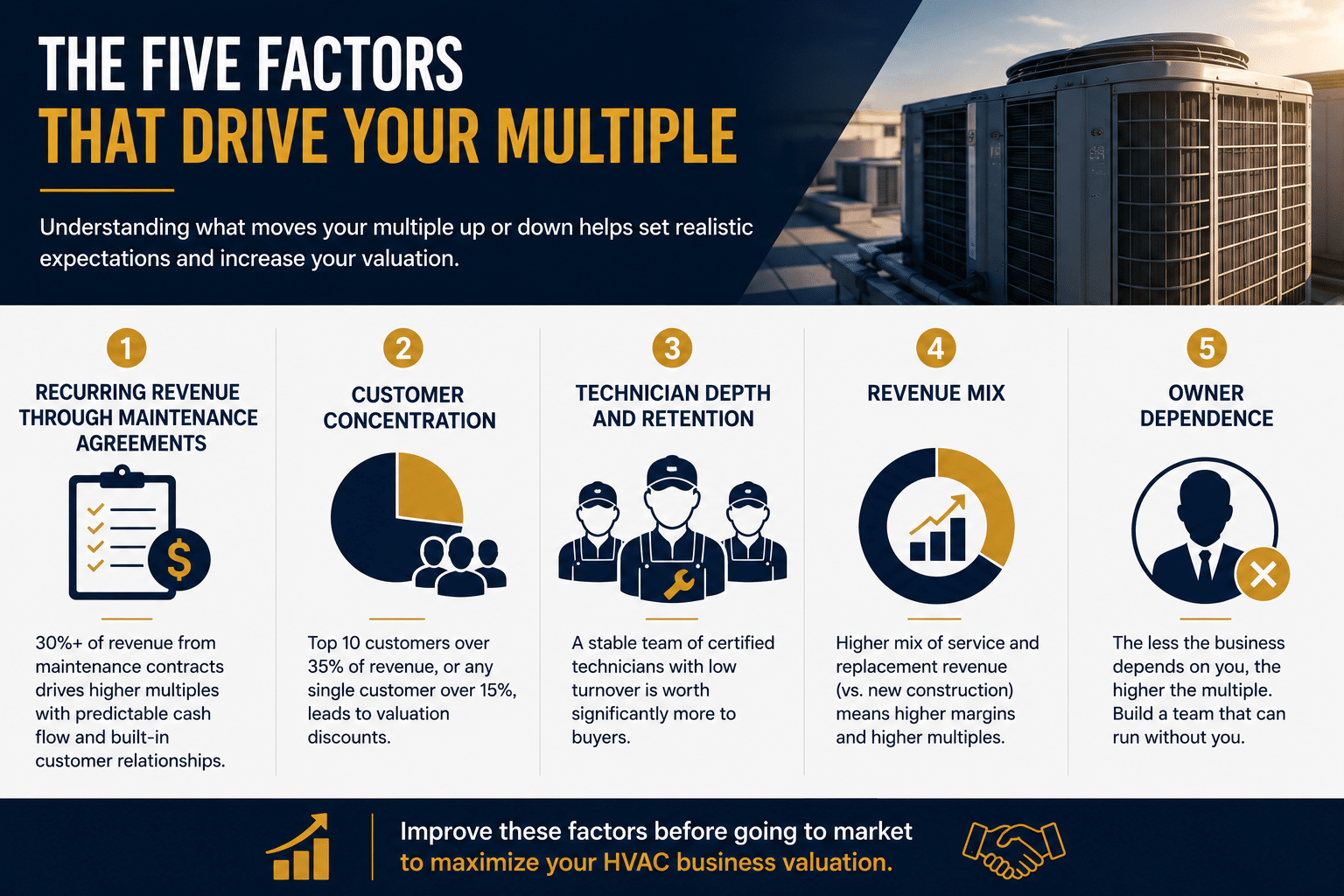
The Five Factors That Drive Your Multiple
Understanding what moves your multiple up or down is essential for both setting realistic expectations and for taking steps to increase your valuation before going to market.
- Recurring revenue through maintenance agreements. HVAC recurring revenue valuation is the single most important driver of your multiple. A company where 30% or more of revenue comes from preventive maintenance contracts will command a materially higher multiple than one dependent entirely on one-time service calls and installations. Buyers value maintenance agreements because they produce predictable cash flow, higher margins, and a built-in customer base for equipment replacement sales. If your recurring revenue is below 20%, building your maintenance agreement base before selling is one of the highest-ROI investments you can make.
- Customer concentration. Customer concentration HVAC valuation adjustments are significant. If your top 10 customers represent more than 35% of revenue, or any single customer exceeds 15%, buyers will apply a discount. This is especially common in commercial HVAC, where a handful of property management relationships can represent a disproportionate share of revenue. Diversifying your customer base before going to market reduces this risk and directly increases your multiple.
- Technician depth and retention. Buyers are purchasing labor capacity as much as they are purchasing revenue. A company with six EPA-certified technicians who have been with the company for three or more years is worth significantly more than one where the owner and a single lead tech handle most of the work. High technician turnover signals operational problems and increases the buyer’s post-closing risk.
- Revenue mix. The ratio of service and replacement revenue to new construction revenue matters. Service and replacement work is higher-margin, more recurring, and less cyclical. New construction revenue is project-based, lower-margin, and tied to the building cycle. Companies with more than 60% of revenue from new construction typically trade at the lower end of the multiple range.
- Owner dependence. This is the factor that most directly limits your valuation. If you are the primary customer relationship holder, the qualifying license holder, the lead estimator, and the person who approves every purchase order, the business cannot run without you. Buyers price this risk heavily. The most impactful thing you can do in the 18 to 24 months before selling is to systematically remove yourself from daily operations and build a management team that can operate independently.
Preparing Your HVAC Business for Sale
The best time to start preparing your HVAC business for sale is 18 to 24 months before you plan to go to market. The preparation process is not about making the business look good for a buyer. It is about making the business genuinely stronger, which increases your valuation and makes the due diligence process smoother.
Financial Preparation
Clean up your books. Buyers and their CPAs will scrutinize your financials during due diligence. Commingling personal and business expenses, running personal vehicles through the company, or maintaining inconsistent accounting practices will either reduce your valuation or kill the deal entirely. Work with your accountant to produce clean, accrual-basis financial statements for at least the three most recent fiscal years.
Understand your quality of earnings. A quality of earnings HVAC analysis normalizes your financials by adding back one-time expenses, owner perks, and non-recurring items while removing revenue or cost items that will not continue post-sale. Many sophisticated sellers commission their own QoE before going to market. This accomplishes two things: it gives you an accurate picture of what your business is worth, and it reduces the chance that the buyer’s QoE analysis produces a lower number that forces a price renegotiation.
Separate your HVAC recurring revenue. Break your revenue into clear categories: maintenance agreement revenue, emergency service revenue, equipment replacement revenue, new installation revenue, and commercial vs. residential. Buyers, particularly private equity firms, will build their valuation model around these categories. The more granular and auditable your revenue breakdown, the more confidence buyers have in the numbers, and the higher your multiple.
Operational Preparation
Document your processes. Standard operating procedures for dispatching, estimating, installation, service callbacks, inventory management, and customer follow-up should be written down and accessible. If the knowledge of how the business runs lives only in your head and your lead technician’s head, the business is not transferable.
Solidify your technician roster. Ensure that all technicians hold current EPA 608 certifications, state-required licenses, and any manufacturer-specific certifications relevant to the brands you service. Review employment agreements and non-compete provisions to confirm they are current and enforceable. If key technicians do not have non-competes, consider implementing them well before the sale process begins.
Address your contractor license situation. If your state HVAC contractor license is held in your personal name rather than through the business entity, the license cannot be sold. You will need to either transition the license to the entity (if your state allows it) or ensure that a qualifying individual who will remain with the business post-sale holds or can obtain the necessary license. This is one of the most commonly overlooked issues in HVAC business sales, and it can delay or derail a closing.
Build your maintenance agreement base. As noted above, recurring revenue is the single biggest premium driver. If your maintenance agreement penetration is below industry averages, an aggressive 12 to 18 month push to grow your agreement base will directly increase your sale price. A company that adds 500 maintenance agreements at $200 per year each has added $100,000 in annual recurring revenue, which at a 2x to 3x valuation premium on recurring revenue alone could translate to $200,000 to $300,000 in additional sale proceeds.
Who Is Buying HVAC Companies?
Understanding who your potential buyers are helps you evaluate offers and structure the deal appropriately.
Private Equity Firms
Private equity has become the dominant buyer in the HVAC market. PE firms pursue two strategies: platform acquisitions (buying a large, well-run company to serve as the foundation for a regional or national roll-up) and add-on acquisitions (buying smaller companies to bolt onto an existing platform). Selling HVAC business to private equity typically means a higher purchase price but also more complex deal terms, including earnouts, rollover equity, and management retention requirements. If you are considering a PE offer, understanding how fractional general counsel supports PE portfolio companies can help you evaluate what post-closing legal support will look like.
HVAC private equity activity has accelerated significantly. Several major platforms have completed dozens of add-on acquisitions each, and new platforms continue to launch. If your company has $1M or more in EBITDA, you are likely already on the radar of multiple PE-backed acquirers.
Strategic Buyers
Strategic buyers are existing HVAC or home services companies looking to expand their geographic footprint, add service capabilities, or acquire a customer base. These buyers typically offer simpler deal structures but may pay lower multiples than PE firms, particularly for add-on-sized companies.
Independent Buyers
Individual buyers, often backed by SBA financing, purchase smaller HVAC companies (typically under $2M in purchase price). These buyers are usually entering the industry for the first time or expanding from another trade. Deal structures with independent buyers tend to involve seller financing and longer transition periods.
HVAC Business Brokers
Most sellers engage an HVAC business broker to manage the sale process. A good broker brings buyer relationships, market knowledge, and deal management experience. Typical broker commissions range from 8% to 12% for smaller deals and 4% to 8% for larger transactions, often structured on a declining scale.
However, your broker represents the deal, not your legal interests. The broker’s job is to close the transaction. Your attorney’s job is to protect your assets and your interests during and after the transaction. These are complementary but distinct roles, and you need both.
Deal Structure: How the Sale Is Structured
The structure of the sale determines your tax outcome, your ongoing obligations, and your exposure to post-closing liability. Getting this right is one of the most consequential decisions in the entire process.
Asset Sale vs. Stock Sale
The asset purchase vs stock purchase decision is the first structural question you will face. Most HVAC business sales are structured as asset sales at the buyer’s request, because asset purchases give the buyer a stepped-up tax basis and allow them to select which liabilities they assume. As the seller, an asset sale may result in a less favorable tax treatment (depending on how the purchase price is allocated across different asset categories), but it also cleanly separates you from the business post-closing.
In a stock sale, you sell your ownership interest in the entity. The entity continues with all its contracts, licenses, and liabilities. Stock sales can be more tax-efficient for sellers (particularly for C-corporations, where an asset sale can trigger double taxation), but they require the buyer to assume all liabilities, which means buyers typically demand more extensive representations, warranties, and indemnification.
The choice between asset sale and stock sale should be made in coordination with your attorney and CPA, because the tax implications can vary by hundreds of thousands of dollars depending on your entity type, the purchase price allocation, and your state’s tax treatment.
Purchase Price Allocation
In an asset sale, the total purchase price is allocated across different asset categories: tangible assets (vehicles, equipment, inventory), intangible assets (customer lists, trade name, non-compete), and goodwill. Each category has different tax treatment.
Buyers prefer to allocate more of the purchase price to assets that can be depreciated quickly (equipment, vehicles), while sellers generally prefer allocations to goodwill and non-compete agreements, which receive capital gains treatment. This allocation is negotiated as part of the purchase agreement and has a direct impact on your after-tax proceeds. Do not agree to purchase price allocation without input from your CPA.
Earnouts and Seller Financing
Many HVAC deals include an earnout component: a portion of the purchase price that is contingent on the business achieving certain financial targets post-closing. Earnouts can bridge a valuation gap between what the seller believes the business is worth and what the buyer is willing to pay at closing.
However, earnouts are one of the most litigated provisions in M&A. The metrics, the measurement period, the buyer’s obligations to operate the business in the ordinary course, and the dispute resolution process must all be defined precisely in the purchase agreement. Vague earnout language almost always benefits the buyer.
Seller financing is common in smaller deals, particularly those involving independent buyers or SBA financing. A typical structure might involve 10% to 20% of the purchase price in the form of a seller note, payable over three to five years. If the buyer is using SBA financing, the SBA will typically require the seller note to be on full standby (no payments) for at least 24 months.

Legal Protection: The Purchase Agreement
The purchase agreement is the single most important document in the transaction. It defines exactly what is being sold, what you are promising about the business, what happens if those promises turn out to be wrong, and what your obligations are after closing.
Representations and Warranties
As the seller, you will make formal representations about the condition of the business: the accuracy of the financial statements, compliance with laws and regulations, the enforceability of contracts, the absence of undisclosed liabilities, the status of employee relationships, and dozens of other topics.
These representations serve as the legal foundation for the buyer’s purchase decision. If a representation turns out to be materially inaccurate, the buyer can seek indemnification from you, even years after closing.
Every representation should be negotiated carefully. Avoid blanket representations where qualified ones are more accurate. Use materiality qualifiers and knowledge qualifiers where appropriate. Disclose everything you know through a comprehensive disclosure schedule. Your attorney’s job is to ensure that the representations accurately describe the business without creating unnecessary exposure.
Indemnification and Escrow
The indemnification provisions determine what happens when a problem surfaces after closing. Key terms include:
Indemnification cap: The maximum amount you can be required to pay. Typical caps range from 10% to 25% of the purchase price for general representations and up to 100% for fundamental representations (ownership, authority, taxes).
Survival period: How long after closing the buyer can make an indemnification claim. Typical survival periods are 12 to 24 months for general representations, with longer periods (up to the statute of limitations) for fundamental representations, tax matters, and environmental liabilities.
Basket or deductible: The minimum aggregate amount of losses the buyer must incur before indemnification kicks in. This prevents the buyer from pursuing nuisance claims for minor post-closing issues.
Escrow: Buyers frequently request that a portion of the purchase price (typically 5% to 15%) be held in escrow for the survival period to secure potential indemnification claims. Negotiate the escrow amount, the release schedule, and the conditions under which the buyer can access the escrowed funds.
Non-Compete and Non-Solicitation Agreements
A non-compete agreement HVAC sale provision is standard in virtually every transaction. You will almost certainly be required to sign a non-compete agreement prohibiting you from operating or working for a competing HVAC business within a defined geographic area for a defined period. Standard terms are three to five years within the company’s service territory.
Non-solicitation provisions prevent you from soliciting the company’s employees and customers. These are typically broader in scope than the non-compete and may extend to five years.
A portion of the purchase price is usually allocated to the non-compete agreement, which has tax implications (non-compete payments are ordinary income, not capital gains). Ensure this allocation is reasonable and that the non-compete terms themselves are enforceable under your state’s law. Overly broad non-competes may be unenforceable, which creates risk for both parties.
Tax Implications of Selling an HVAC Business
Understanding the tax implications selling HVAC business owners face is critical to maximizing your after-tax proceeds. The tax treatment depends on several factors: your entity type (LLC, S-Corp, C-Corp), whether the deal is structured as an asset sale or stock sale, how the purchase price is allocated, and your state’s specific tax rules.
For S-Corps and LLCs taxed as partnerships, the gain on a stock or membership interest sale is generally treated as long-term capital gains (taxed at a lower rate). An asset sale flows through the entity and may produce a mix of ordinary income and capital gains depending on the asset allocation.
For C-Corps, an asset sale can trigger double taxation: the corporation pays tax on the gain from the asset sale, and then you pay tax again when the after-tax proceeds are distributed to you as a dividend or liquidation distribution. This double-tax issue is one of the primary reasons C-Corp sellers prefer stock sales.
State taxes add another layer. Some states conform to federal treatment, while others have their own rules for business sale taxation. California, for example, taxes capital gains as ordinary income.
Work with a CPA who has experience in business sale transactions to model the after-tax proceeds under different deal structures before you agree to terms. The difference between a well-structured and poorly-structured deal can be 10% to 20% of the total sale price in taxes alone.
The Due Diligence Process: What Buyers Will Review
Once you accept a letter of intent, the buyer will conduct due diligence on every aspect of the business. Before opening your books, ensure the buyer has signed a comprehensive non-disclosure agreement to protect your confidential information. Understanding what buyers will look for helps you prepare and avoids surprises that can delay closing or lead to price renegotiation.
Financial Due Diligence
Buyers will request three to five years of financial statements, tax returns, bank statements, accounts receivable and payable aging, revenue by customer, revenue by service category, and payroll records. If the buyer is a private equity firm, they will commission a quality of earnings report that normalizes your financials and tests the durability of your revenue.
The most common issues that surface during financial diligence: personal expenses commingled with business expenses, revenue recognized inconsistently, undisclosed cash transactions, and deferred maintenance on vehicles and equipment that inflates short-term profitability.
Legal Due Diligence
Buyers will review every material contract, lease, employment agreement, vendor agreement, insurance policy, and regulatory filing. They will search for liens, judgments, and pending litigation. They will verify that all licenses and permits are current and transferable.
For HVAC businesses, specific legal diligence items include: contractor license verification and transferability, EPA 608 compliance records, refrigerant tracking logs, OSHA 300 logs, warranty obligation estimates, and review of maintenance contract assignment provisions.
Operational Due Diligence
Buyers will assess your fleet condition, inventory, equipment, technology systems, customer relationship management tools, and dispatch processes. They will interview key employees (with your permission) and may request ride-alongs with service technicians to observe field operations.
How Long Does It Take to Sell an HVAC Business?
The timeline from deciding to sell to closing typically runs 6 to 12 months:
Months 1 to 2: Preparation. Clean financials, organize documents, address any operational issues, engage your attorney and broker.
Months 2 to 4: Marketing. The broker takes the business to market, screens buyers, conducts tours, and manages the offer process.
Months 4 to 5: LOI negotiation and execution. Agree on price, structure, and key terms. Enter exclusivity.
Months 5 to 8: Due diligence. The buyer reviews the business in detail. Address any issues that surface. Negotiate the purchase agreement.
Months 8 to 10: Closing preparation. Finalize the purchase agreement, satisfy closing conditions, obtain necessary consents, coordinate with lenders.
Month 10+: Closing and transition. Sign, fund, and begin the transition period.
Delays most commonly result from financing issues, unresolved diligence findings, license transfer complications, and purchase agreement negotiations. Having your legal and financial documentation organized before going to market is the single most effective way to compress the timeline.
HVAC Owner Retirement and Exit Planning
An HVAC owner retirement exit is one of the most common reasons businesses come to market. If your exit is driven by retirement, additional planning considerations come into play. Business succession planning, estate planning, and the coordination between your business sale and your personal financial plan all require advance work.
Consider whether you want a clean break at closing or whether you are willing to stay involved during a transition period. Most buyers request a 6 to 12 month transition, during which you introduce customers, train the new owner or management team, and ensure continuity. The terms of this transition, including your compensation, your role, and the conditions under which either party can terminate the arrangement, should be defined clearly in the purchase agreement.
If you are transferring the business to a family member or key employee rather than selling to an outside buyer, the legal considerations are different but equally important. Internal transfers often involve seller financing, management buyout structures, and tax planning strategies that require specialized legal and accounting guidance.
When You Need a Lawyer
You can estimate your valuation, organize your documents, and interview brokers on your own. But several aspects of selling an HVAC business require an experienced HVAC business sale attorney:
- Deal structure analysis with your CPA to determine whether an asset sale or stock sale produces the best after-tax result for your specific situation
- Purchase agreement negotiation, including representations, warranties, indemnification caps, survival periods, escrow terms, and earnout provisions
- Non-compete and non-solicitation agreement review to ensure the terms are reasonable, enforceable, and properly compensated
- Tax allocation negotiation to optimize the purchase price allocation across asset categories
- Due diligence preparation and response management to prevent deal delays and price renegotiation
- Closing coordination with the buyer’s counsel, lenders, and brokers
At Next Era Legal, we serve as fractional general counsel for home services companies across the country. We have represented sellers in transactions ranging from single-truck residential operations to multi-location commercial platforms. Our role is not to replace your broker. It is to ensure that the deal your broker negotiates actually protects you, your family, and the wealth you have built over a career in this industry.
Thinking about selling your HVAC business? Schedule a Consultation
Frequently Asked Questions
How much is my HVAC business worth?
HVAC businesses typically sell for 2.5x to 4.0x SDE for owner-operated companies and 4.0x to 10.0x EBITDA for larger businesses with management teams. The most significant valuation drivers are recurring revenue from maintenance agreements, customer concentration, technician retention, revenue mix (service vs. new construction), and owner dependence. A quality of earnings analysis provides the most accurate picture of what buyers will pay.
Should I sell my HVAC business as an asset sale or stock sale?
Asset sales are more common and are generally preferred by buyers because they offer tax advantages and liability protection. Stock sales can be more favorable for sellers, particularly C-Corp owners who want to avoid double taxation. The choice depends on your entity type, the purchase price, the buyer’s requirements, and the complexity of transferring contracts and licenses. Your attorney and CPA should model both structures.
How do I find a buyer for my HVAC business?
Most HVAC business sales are facilitated by business brokers who specialize in the home services or construction sector. HVAC business brokers typically charge 4% to 12% of the sale price. Private equity firms also actively source HVAC acquisitions directly. If your company has $1M or more in EBITDA, you may receive inbound inquiries from PE-backed buyers without engaging a broker.
What does a buyer look for during HVAC due diligence?
Buyers examine financials (revenue by category, margins, quality of earnings), operations (fleet condition, inventory, technology), workforce (technician certifications, retention rates, employment agreements), legal (licenses, contracts, compliance history, pending litigation), and customer relationships (concentration, contract terms, satisfaction). The most common deal-killers are undisclosed liabilities, owner dependence, customer concentration above 50%, and licensing issues that cannot be resolved before closing.
How long should the transition period be after selling?
Most HVAC business sales include a 6 to 12 month transition period where the seller introduces customers, supports the new owner or management team, and ensures operational continuity. The transition should be governed by a written agreement specifying your role, compensation, schedule, and the conditions for early termination. Some sellers negotiate a consulting arrangement rather than employment to maintain flexibility and favorable tax treatment.
Can I sell my HVAC business if I hold the contractor license personally?
Yes, but it adds complexity. If the HVAC contractor license is in your name, the buyer will need to ensure that they or an employee hold the appropriate license before closing, or before you depart after the transition period. This is one of the most commonly overlooked issues in HVAC business sales and should be addressed early in the planning process to avoid delays.
Disclaimer
All information is for educational purposes only and does not constitute legal advice or form an attorney-client relationship.