
Your service agreement is one of the most important legal documents in your business. Most home service operators treat it like paperwork.
It determines whether you win or lose a chargeback dispute. It determines whether a fee increase triggers a customer fight or goes through without friction. It determines what happens when a job changes mid-installation, when a customer cancels after work has begun, or when a commercial client disputes your invoice 90 days after the fact.
A service agreement drafted from a template years ago and never updated is not doing any of those jobs.
We build master service agreements for home service companies, HVAC, plumbing, electrical, roofing, landscaping, and related trades, that are designed for how these businesses actually operate today.
Why This Matters More Right Now Than It Did Three Years Ago
The home service industry has changed in ways that have made outdated service agreements significantly more expensive to carry.
Chargebacks and refund disputes have increased across the trades. Credit card networks, third-party financing platforms, and consumer protection agencies have all lowered the friction cost for customers to formally challenge a charge. A dissatisfied customer no longer has to file a lawsuit or pursue arbitration. They can initiate a chargeback from their phone within days of a completed job. When that happens, the dispute gets resolved based on documentation. The contractor who wins is usually the one whose agreement captured written approval, defined the scope, and documented what was acknowledged at the time of service.
Fee increases have become necessary and complicated at the same time. Equipment costs, labor rates, insurance premiums, and refrigerant prices have all risen sharply. Tariffs on imported HVAC components added another layer of cost pressure in 2025. Operators who need to raise prices on maintenance agreements and subscription plans are discovering that their agreements provide no mechanism to do it without reopening the conversation with every customer.
Private equity and commercial buyers are asking harder questions. As consolidation accelerates in the home services sector, operators who are preparing for a sale, a PE partnership, or a commercial contract with a property management company are finding that their service agreements are the first thing an outside party examines. Inconsistent terms, missing provisions, and template language that does not reflect actual business practices create friction at exactly the wrong moment.
A well-structured MSA solves all three of these problems before they arrive.
What a Master Service Agreement Actually Does
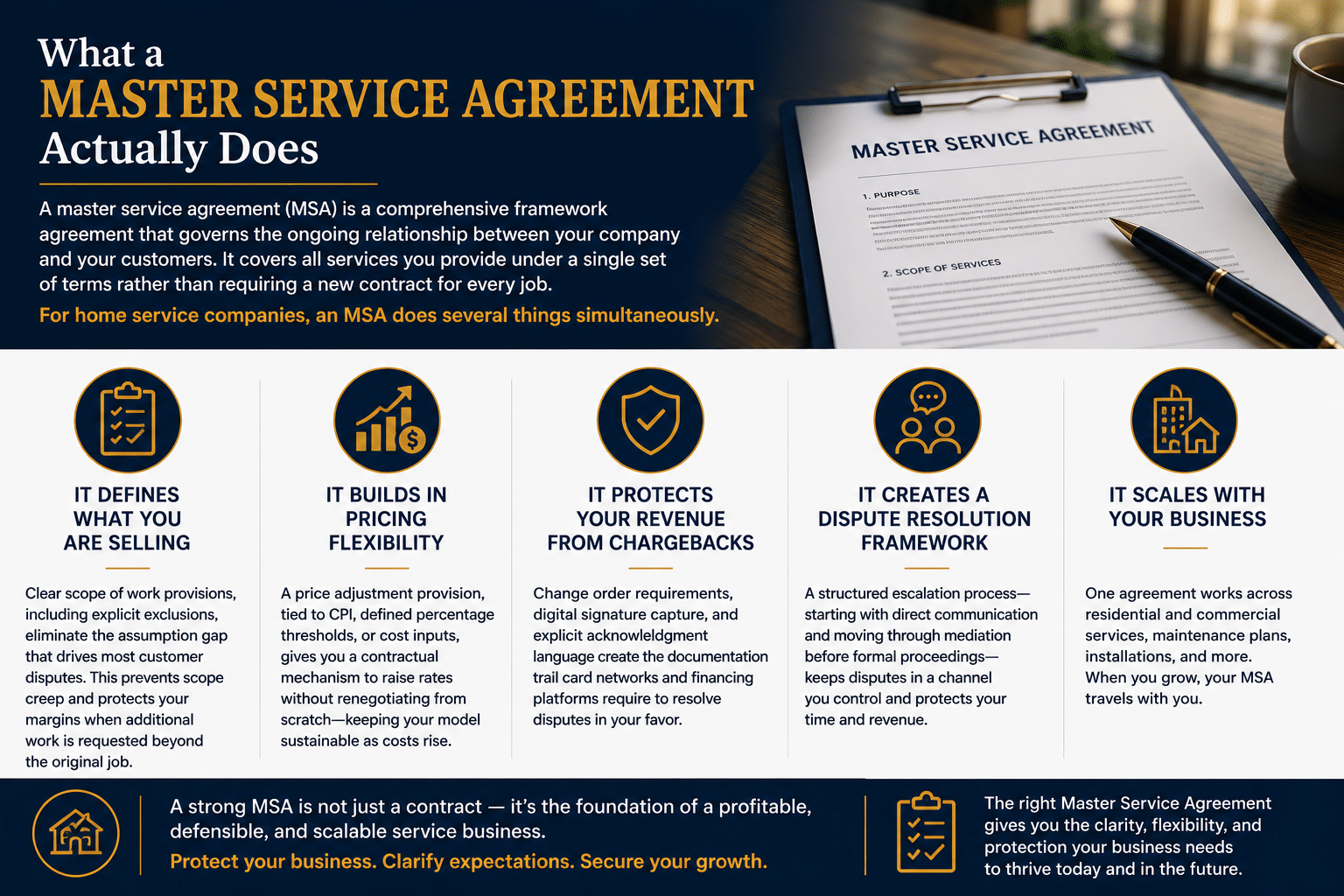
A master service agreement (MSA) is a comprehensive framework agreement that governs the ongoing relationship between your company and your customers. It covers all services you provide under a single set of terms rather than requiring a new contract for every job.
For home service companies, an MSA does several things simultaneously.
It defines what you are selling
Clear scope of work provisions, including explicit exclusions, eliminate the assumption gap that drives most customer disputes. When customers know exactly what is included and what is not, they cannot claim surprise when the invoice reflects that boundary. This also prevents scope creep and protects your margins when additional work is requested beyond the original job.
It builds in pricing flexibility
An MSA that includes a price adjustment provision, tied to CPI, defined percentage thresholds, or cost inputs, gives you a contractual mechanism to raise rates without renegotiating from scratch. The increase is part of the agreement, not an exception to it. For operators running maintenance plans or subscription-based service programs, this provision is not optional. It is the difference between a sustainable model and one that erodes over time as costs rise against fixed pricing.
It protects your revenue from chargebacks
Change order requirements, digital signature capture, and explicit acknowledgment language create the documentation trail that card networks and financing platforms require to resolve disputes in your favor. Without it, the documentation burden falls on you and you are almost always starting from behind. Most home service operators who lose chargeback disputes do not lose because the work was wrong. They lose because the paperwork did not capture what was agreed to.
It creates a dispute resolution framework
When disagreements happen, and they will, an MSA with defined dispute resolution provisions keeps the conversation in a channel you control. A structured escalation process, starting with direct communication and moving through mediation before reaching formal proceedings, protects your time and your revenue. Without that provision, your only options when a customer disputes a charge are to capitulate or to watch the dispute go somewhere you have less influence.
It scales with your business
A well-structured MSA works at one location and at ten. It covers residential and commercial relationships under the same framework, with slight tweaks for each. It supports maintenance plan offerings, one-time service calls, installation contracts, and commercial property management agreements without requiring a different document for each service category. When you expand to new markets or add new service lines, the MSA travels with you.
What an Outdated Agreement Actually Costs
The cost of a weak service agreement is not always visible on any single invoice. It accumulates in ways that take time to recognize.
Chargeback losses hit the direct revenue line. The average chargeback costs a merchant the disputed amount plus a processing fee, plus the administrative time to respond. For home service companies running high volumes of credit card and financing transactions, a chargeback rate that should be well under one percent can quietly erode several points of margin if documentation gaps are making disputes difficult to contest.
Refund demands that get accommodated to avoid conflict are often the larger number. Most operators absorb more refund requests informally than they ever contest formally, because their agreements give them nothing to point to. A customer expresses dissatisfaction, the company issues a partial or full refund to make the conversation end, and the cost never gets categorized as a legal or contract problem. It gets buried in customer relations or written off as a cost of doing business.
Fee increases that fail cost more than the revenue gap. When a price increase triggers a customer cancellation, the lost recurring revenue from that maintenance plan often exceeds the increase itself several times over. Operators who find themselves unable to raise prices without meaningful attrition are often facing a contract problem, not a customer relations problem. The agreement never established that pricing was subject to adjustment, so every increase reads as a unilateral change.
The commercial opportunity cost is harder to quantify but often the largest number. Property management companies, commercial real estate operators, and institutional clients routinely require MSA documentation before awarding service contracts. Home service companies that cannot produce a formal, current, compliant MSA may be excluded from commercial contract opportunities that their operational capabilities would otherwise support.

What We Build
Every MSA we draft for a home service company includes the following components, written for the specific business, not adapted from a generic template.
Scope of Work and Exclusions
Detailed definitions of what each service category includes, explicit exclusions for conditions and work types not covered, and a change order process for situations where the job scope changes mid-service. The scope language is written around how jobs are actually sold and performed, not around generic contractor definitions that leave room for customer interpretation.
Pricing and Payment Terms
Clear payment terms, late fee provisions, service call fee structures, and price adjustment language that supports your ability to raise rates on maintenance plans and subscription offerings without triggering disputes. For companies running tiered maintenance plans, the payment terms are structured to reflect the actual service tiers and the conditions under which pricing adjusts.
Consumer Protection Disclosures
State-specific disclosures required for home improvement contractors in California, Michigan, Illinois, and other states where our clients operate. Consumer protection compliance is built into the agreement structure, not added as an afterthought. For companies operating across multiple states, the disclosure requirements differ meaningfully, and the MSA reflects those differences rather than defaulting to the least protective common standard.
Cancellation and Refund Framework
Defined terms for what happens when a customer cancels before work begins, after work begins, and after work is completed. These provisions do not eliminate refund requests. They give you a framework to respond to them professionally and consistently, and they provide documentation that card networks and financing platforms require when a chargeback is filed after a refund request was denied or partially granted.
Dispute Resolution
A structured process for raising and resolving disagreements, including direct communication requirements, mediation provisions, and arbitration clauses where appropriate for your business model and jurisdiction. The dispute resolution framework is designed to keep disagreements out of formal channels whenever possible, while giving you a defensible process when formal channels become necessary.
Renewal and Evergreen Provisions
For maintenance agreement and subscription plan offerings, renewal terms that include notification requirements and price adjustment mechanisms so that each renewal cycle does not require a new negotiation. Automatic renewal language that complies with state auto-renewal laws in California and other jurisdictions where specific notice and cancellation requirements apply to subscription-based consumer agreements.
Multi-State Compliance
For operators working across state lines, or planning to, compliance requirements vary significantly between states. California has specific contractor licensing and consumer protection requirements. Michigan and Illinois have their own notice and cancellation frameworks. We draft separate, jurisdiction-specific agreements for each state where you operate. Compliance requirements differ enough between California, Michigan, and Illinois that a single document covering all of them usually compromises one or more. You get agreements built for each market, not adapted for it.
How It Fits Into Fractional GC
For home service companies engaged in our Fractional GC program, the MSA is the starting point of the legal infrastructure. It connects to your workforce classification framework, your vendor agreements, and your operational compliance in a single coherent structure. The MSA is not a standalone document. It is the foundation that other legal infrastructure builds on. For operators who are not ready for an ongoing fractional GC engagement, we also offer MSA drafting and review as a standalone project.
Either way, the output is the same: a service agreement that actually protects your business instead of just documenting the transaction.
Who This Is For
Home service companies at the growth stage, typically $5M to $100M in annual revenue, are the operators who get the most immediate value from a properly structured MSA. The legal exposure at this stage is real and growing, and the complexity of the business has often outpaced the agreements that were written for an earlier version of it.
Operators seeing more chargebacks and refund demands than they did two or three years ago are almost always dealing with a documentation gap, not a customer behavior problem. The dispute landscape changed. Their agreements did not.
Operators preparing for fee increases on maintenance plans and subscription offerings need the contractual mechanism to execute those increases without renegotiating with every customer. If the agreement does not support the increase, the options are absorb the cost or accept the attrition. Neither is acceptable at scale.
Operators expanding to multiple locations or new markets need agreements that travel with them. Inconsistent terms across locations create audit problems, commercial contracting problems, and diligence problems when a buyer or investor starts asking questions.
Operators pursuing commercial contracts with property management companies, facility managers, or institutional clients need formal MSA documentation as a baseline requirement. Many commercial clients will not award a contract without reviewing the service agreement first.
Operators preparing for a sale, a PE investment, or franchise development need clean contract infrastructure before they enter that process. Building it under diligence pressure is expensive and incomplete.
Frequently Asked Questions
How is an MSA different from the service agreement we already use?
Most home service companies use a service agreement, a maintenance agreement, or a combination of both. An MSA is a framework agreement that governs the overall relationship, with specific job terms documented separately for each engagement. The practical difference is that an MSA covers multiple service types and an ongoing relationship under a single set of governing terms, rather than requiring a new agreement for each job or service category. For companies that do both residential and commercial work, run maintenance plans alongside one-time service calls, and operate in multiple states, an MSA creates consistency that individual job agreements cannot.
Do we need to get our existing customers to sign a new agreement?
Not necessarily all at once. For customers on active maintenance plans or subscription agreements, the right approach depends on the renewal structure and the changes being made. New customers sign the updated agreement at enrollment. Existing customers typically transition at renewal. For commercial clients, renegotiation is often an opportunity rather than an obstacle, since a formal MSA signals operational maturity. We work through the transition strategy as part of the drafting process so there is a clear plan for deployment before the document is finalized.
How long does it take to draft an MSA?
For a standalone MSA project, the drafting process typically runs two to four weeks from initial review through final delivery. The timeline depends on the complexity of the service offerings, the number of states the agreement needs to cover, and how much existing agreement language and operational documentation is available to work from.
What does it cost?
MSA drafting project cost depends on scope, which we establish in an initial conversation before any commitment, but a starting point is $3,500. There are no hourly billing surprises. The engagement letter defines the scope and the cost before work begins.
We operate in multiple states. Does one MSA cover all of them?
Yes and no. If you operate through a CRM that allows including certain provisions and disposing of others, then we can provide one MSA that has instructions on when to remove which parts. If it is easier for your operations, so people do not have to make that determination while on the job, we can draft separate MSAs. A majority of each will be the same and only state specific laws will be updated, but you will not be paying for separate MSAs for each state.
Our current agreements came from our field service software. Is that sufficient?
Field service platforms provide templates that are designed to be broadly applicable across many different types of home service businesses. They are a reasonable starting point for new companies, but they almost never reflect the specific way an established business operates, the specific states in which it does business, or the specific service categories and pricing structures it uses. The gaps in these templates are usually not visible until a dispute surfaces. At that point, the agreement is being evaluated by a card network or a mediator, not by the contractor who thought it was sufficient.
Disclaimer
All information is for educational purposes only and does not constitute legal advice or form an attorney-client relationship.