

Subcontractors are a critical part of how most HVAC companies operate. Whether you bring in subs for overflow installation work, specialized commercial projects, after-hours emergency coverage, or geographic reach into markets where you do not have your own crews, the subcontractor relationship creates legal and financial exposure that a handshake and a purchase order cannot manage.
An HVAC subcontractor agreement is the contract that defines the terms of that relationship: what work the sub is authorized to perform, who carries the insurance, who is liable when something goes wrong, and what happens when the relationship ends. Without a written agreement, or with a poorly drafted one, you are exposed to liability for the subcontractor’s mistakes, misclassification penalties from the IRS, and the risk that your sub walks away with your customers.
This guide covers what every HVAC subcontractor agreement should include, the legal risks that contractors face when using subs, and the provisions that protect your business, your customers, and your brand.
Why a Written Subcontractor Agreement Is Non-Negotiable
Many HVAC contractors operate their subcontractor relationships informally. The sub shows up, does the work, sends an invoice, and gets paid. No written agreement. No insurance verification. No defined scope. This works fine until it does not, and when it stops working, the consequences are expensive.
Without a written agreement, you have no contractual basis to hold the sub accountable for quality issues, delays, or customer complaints. You have no indemnification protection if the sub causes property damage or injures someone on the job. You have no non-solicitation provision preventing the sub from contacting your customers directly. And you have a much harder time defending a worker classification audit because the IRS looks at the entire relationship, including whether there is a written contract defining the sub as an independent contractor.
A well-drafted subcontractor agreement addresses all of these risks. It costs far less to draft than it costs to litigate any one of these issues.

Essential Provisions in Every HVAC Subcontractor Agreement
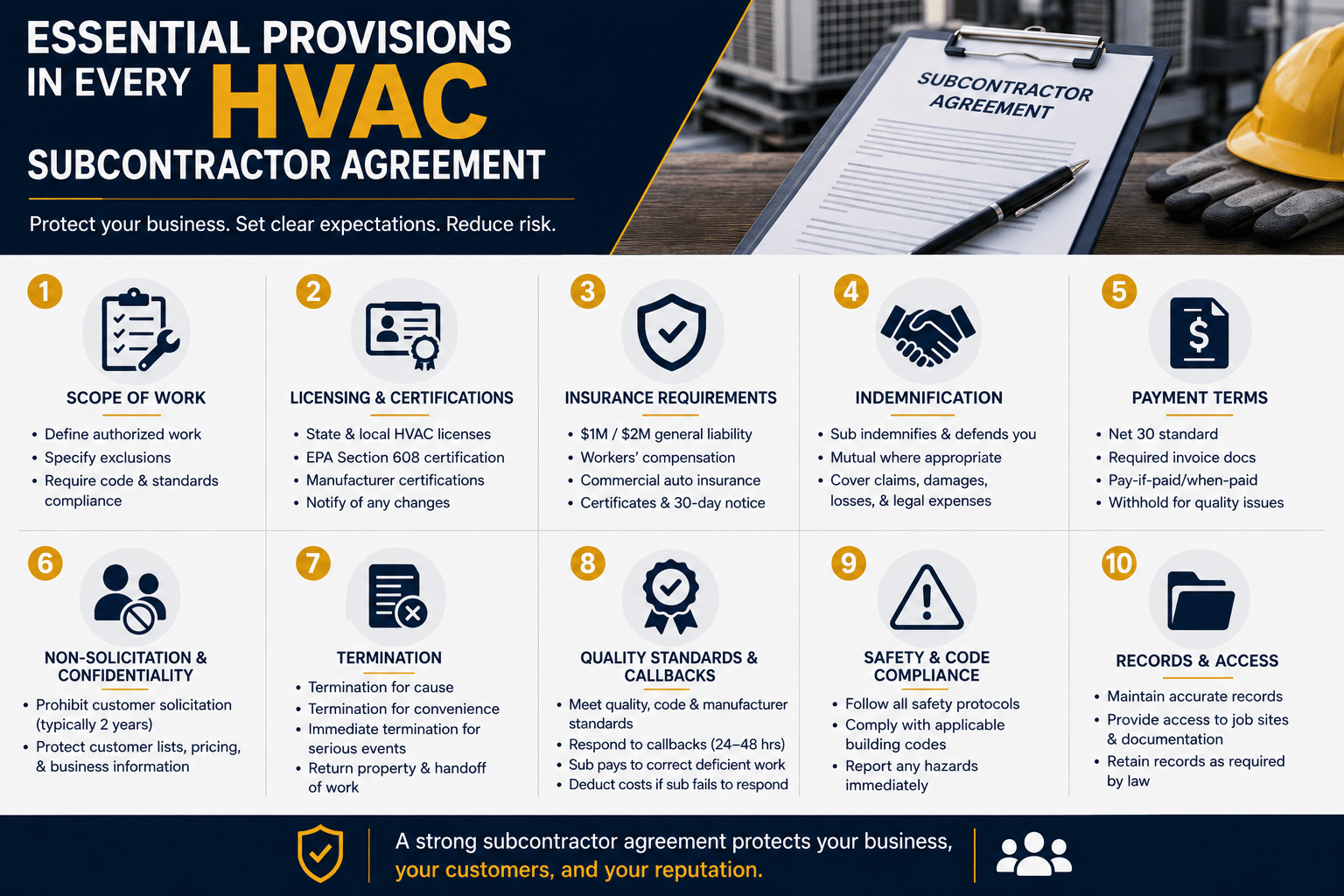
Scope of Work
Define exactly what work the subcontractor is authorized to perform. For HVAC, this might include residential installation, commercial installation, ductwork fabrication, refrigeration work, controls and automation, or specific manufacturer warranty service.
The scope should also define what the sub is not authorized to do. If you only want them installing equipment and not performing service calls or selling maintenance agreements, that needs to be in writing. Unclear scope boundaries lead to subcontractors operating beyond their authorized role, which creates liability for you and confusion for your customers.
Include a provision requiring the sub to perform all work in accordance with applicable building codes, manufacturer installation specifications, and your company’s standard operating procedures. This gives you a clear basis for rejecting substandard work and withholding payment until corrections are made.
Licensing and Certification Requirements
Every HVAC subcontractor must hold the appropriate licenses and certifications for the work they perform. Your agreement should require the sub to maintain, at minimum:
- State and local HVAC contractor licenses in every jurisdiction where they will perform work. Verify these independently before the sub begins any work. Do not rely on their representations alone.
- EPA Section 608 certification for any technician handling refrigerants. The certification must be the appropriate type (Type I, II, III, or Universal) for the work being performed.
- Manufacturer certifications if the sub will be working on equipment that requires authorized service for warranty compliance.
Include a provision requiring the sub to notify you immediately if any license or certification is suspended, revoked, or expired. Make license compliance a material obligation under the agreement, with termination rights if the sub fails to maintain required credentials.
Insurance Requirements
Insurance is where many HVAC contractors get caught. If your subcontractor causes property damage or injures someone and does not have adequate insurance, the claim falls back on you.
Your agreement should require the sub to carry:
- General liability insurance with minimum limits of $1M per occurrence and $2M aggregate. Your company should be named as an additional insured on the sub’s policy, which means you are covered under their policy for claims arising from their work.
- Workers’ compensation insurance as required by state law. This is critical. If the sub has employees and does not carry workers’ comp, you can be held liable for injuries to their workers under most states’ subcontractor liability statutes.
- Commercial auto insurance if the sub uses vehicles in connection with the work.
Require the sub to provide certificates of insurance before beginning any work and to notify you at least 30 days before any policy is cancelled or materially changed. Verify the certificates directly with the insurance carrier, as fraudulent certificates are more common than most contractors realize.
Indemnification
The indemnification clause is your primary legal protection against claims arising from the subcontractor’s work. A well-drafted provision requires the sub to indemnify, defend, and hold you harmless from any claims, damages, losses, and expenses arising from their performance of the work, including claims for property damage, bodily injury, and violations of law.
Make sure the indemnification is mutual where appropriate: you should indemnify the sub for claims arising from your own negligence. But the sub’s indemnification obligation should cover all claims arising from their work, their employees, and their failure to comply with the agreement.
Some states restrict or limit indemnification provisions in construction contracts. Your attorney should draft this clause with your state’s specific contract requirements in mind to ensure enforceability.
Payment Terms
Define how and when the sub gets paid. Standard terms include net 30 from invoice submission, with invoices submitted weekly or upon completion of each job. Specify any documentation required with each invoice: completed work orders, customer sign-offs, photos, and permit documentation.
Include a pay-if-paid or pay-when-paid provision if you want to tie subcontractor payment to your receipt of payment from the customer. These provisions are enforceable in most states but must be clearly drafted.
Retain the right to withhold payment for work that does not meet your quality standards, pending completion of corrections. Define the process for disputing invoices so that disagreements do not escalate into litigation unnecessarily.
Non-Solicitation and Confidentiality
This is one of the most overlooked provisions in HVAC subcontractor agreements, and it is one of the most important.
- Non-solicitation. Prohibit the subcontractor from directly soliciting your customers for a defined period after the relationship ends, typically two years. Without this clause, your sub can build relationships with your customers on your dime and then approach them directly for future work. This is especially common in HVAC, where the technician who shows up at the customer’s door is the face of the service experience.
- Confidentiality. Require the sub to keep your customer lists, pricing structures, operational processes, and business information confidential. A non-disclosure agreement can be incorporated into the subcontractor agreement or executed as a standalone document. Either way, it is essential. Your customer database and pricing models represent significant intellectual property that needs contractual protection.
Termination
Define clear termination rights for both parties. Standard provisions include:
- Termination for cause. Either party can terminate if the other commits a material breach and fails to cure within a defined period (typically 10 to 15 business days after written notice).
- Termination for convenience. Either party can terminate without cause with a defined notice period (typically 30 days). This gives both sides an exit without requiring a breach.
- Immediate termination. You should have the right to terminate immediately, without a cure period, for certain serious events: loss of required licenses, failure to maintain required insurance, safety violations, fraud, or any act that threatens your company’s reputation or customer relationships.
Include provisions addressing what happens at termination: return of your company’s property (uniforms, badges, vehicle wraps, customer records), completion or handoff of work in progress, and final payment terms.
Quality Standards and Callbacks
Define your quality expectations and the process for handling callbacks and warranty claims on the subcontractor’s work. Your agreement should specify that the sub is responsible for the cost of correcting any work that does not meet your company’s standards, applicable building codes, or manufacturer specifications.
Include a provision requiring the sub to respond to callback requests within a defined timeframe (typically 24 to 48 hours for standard issues, same-day for emergencies). If the sub fails to respond to a callback, you should have the right to have the work corrected by another technician and deduct the cost from the sub’s next payment. This protects your customer relationships and ensures that quality issues do not linger.
Worker Classification: The Hidden Risk
Every HVAC subcontractor relationship carries worker misclassification risk. If the IRS or your state’s department of labor determines that your “subcontractor” is actually an employee, the consequences include back payroll taxes, unpaid benefits, penalties, and potential liability for workers’ compensation claims.
The classification analysis looks at the totality of the relationship: how much control you exercise over the sub’s work, whether the sub provides their own tools and equipment, whether the sub works for other companies, whether the sub has the opportunity for profit or loss, and the permanence of the relationship.
Your subcontractor agreement should reinforce the independent contractor relationship by clearly stating that the sub is an independent contractor, requiring the sub to provide their own tools and equipment, allowing the sub to work for other companies, defining the relationship as project-based rather than ongoing, and avoiding provisions that look like employment (required work hours, company uniforms, mandated tools).
Even with a well-drafted agreement, the actual working relationship must match what the contract says. If your “subcontractor” works exclusively for you, uses your tools, wears your uniform, and follows your daily schedule, no contract will overcome that reality in an audit.
The consequences of misclassification are substantial. Beyond back payroll taxes and penalties, you may owe retroactive benefits, overtime pay, and workers’ compensation premiums. In some states, the business owner can face personal liability. The IRS and state labor departments have increased enforcement activity in the construction and home services sector, making this one of the highest-priority compliance areas for HVAC contractors who rely on subcontractors for any portion of their workforce.
Dispute Resolution
Include a dispute resolution clause specifying how disagreements are handled. A stepped approach works well: require the parties to attempt informal resolution first, then mediation, then binding arbitration. This keeps most disputes out of court and reduces resolution costs for both sides.
Specify the governing law, venue, and which party bears the costs of mediation or arbitration. For smaller disputes (under $10,000), consider a simplified arbitration process with expedited timelines to prevent the cost of resolution from exceeding the amount in dispute.
When to Have Your Subcontractor Agreements Reviewed
If you are using subcontractors without a written agreement, or if your agreement is a template that has not been reviewed by an attorney, you are carrying risk that is easily preventable.
At Next Era Legal, we serve as fractional general counsel for home services companies including HVAC contractors, plumbers, electricians, and roofing companies. We draft subcontractor agreements, employment contracts, service agreements, and the full suite of business contracts that contractors need to operate and grow with confidence.
Need a subcontractor agreement drafted or reviewed? Schedule a Consultation
Disclaimer
All information is for educational purposes only and does not constitute legal advice or form an attorney-client relationship.