
Your HVAC service agreement is the document that defines the relationship between your company and every customer you serve. It determines what you are obligated to do, what happens when something goes wrong, how and when you get paid, and what your exposure is when a system fails on a 100-degree day. It is the single most important legal document in your business, and most HVAC contractors are operating with one that was copied from a competitor, downloaded from a template site, or written 10 years ago and never updated.
That is a problem. The HVAC industry has changed significantly. Equipment complexity has increased. Regulatory requirements have expanded. Customer expectations around response times, guarantees, and communication have risen. And the legal landscape around indemnification, limitation of liability, and consumer protection has evolved in ways that make outdated contract language a genuine business risk.
This guide is written for HVAC business owners and operators who want to understand what belongs in a service agreement, why each provision matters, and how the right contract language protects your company from disputes, liability, and lost revenue. Whether you are drafting your first HVAC service contract or overhauling an existing one, this is the legal framework you need.
Types of HVAC Service Agreements
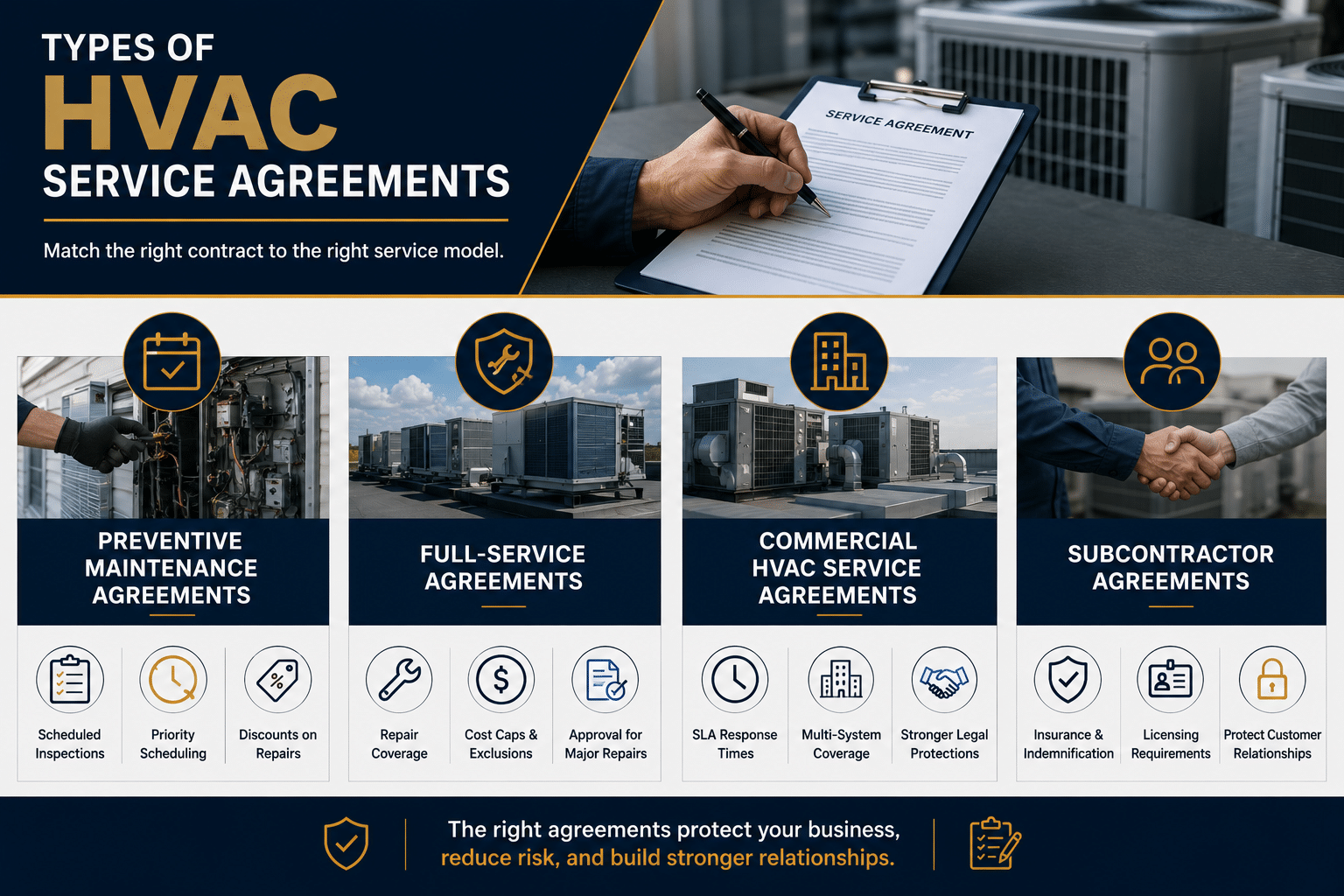
Not every customer relationship requires the same contract. Understanding the different types of agreements allows you to match the right contract to the right service model.
Preventive Maintenance Agreements
An HVAC preventive maintenance contract is the foundation of recurring revenue for most HVAC businesses. These agreements typically cover two visits per year (one for heating, one for cooling), during which technicians perform a defined checklist of inspection, cleaning, and calibration tasks. Many maintenance agreements also include priority scheduling, discounts on repairs, and reduced diagnostic fees.
From a legal perspective, the maintenance agreement must clearly define exactly what is included in each visit, what is excluded (parts, refrigerant, repairs beyond the scope of the tune-up), and what happens if the technician discovers a problem during the visit. Ambiguity in scope is the most common source of HVAC contract disputes related to maintenance agreements.
Full-Service Agreements
Full-service agreements go beyond preventive maintenance to include some or all repair coverage. These are more common in commercial HVAC, where building owners want predictable costs and guaranteed response times. The contract must specify which repairs are covered, any per-incident or annual caps on repair costs, exclusions for pre-existing conditions or equipment beyond its useful life, and the process for approving repairs that exceed the coverage limits.
Commercial HVAC Service Agreements
A commercial HVAC service agreement involves additional complexity compared to residential contracts. Commercial systems are larger, more complex, and often mission-critical for the customer’s operations. These agreements typically include service level agreements (SLAs) with defined response times and resolution windows, after-hours and emergency service provisions, multiple-system coverage across different equipment types, and more detailed indemnification and insurance requirements.
Commercial agreements also need to address multi-location coverage, equipment inventory and asset tagging, and the process for handling warranty claims on behalf of the building owner with equipment manufacturers.
Subcontractor Agreements
If your business uses subcontractors for overflow work, specialized installations, or specific geographic coverage, you need a separate HVAC subcontractor agreement that governs that relationship. This agreement should define the scope of work the subcontractor is authorized to perform, require the subcontractor to carry their own insurance and name your company as an additional insured, include indemnification provisions that protect you from claims arising out of the subcontractor’s work, and address licensing requirements to ensure the subcontractor holds all required state and local HVAC contractor licenses.
The subcontractor agreement should also include provisions protecting your customer relationships, including non-solicitation clauses that prevent the subcontractor from directly soliciting your customers for a defined period after the relationship ends. A non-disclosure agreement should accompany the subcontractor agreement to protect your pricing structures, customer lists, and proprietary service processes.
Essential Clauses in Every HVAC Service Agreement
The clauses below are the legal backbone of your HVAC service contract. Each one addresses a specific risk or operational requirement that HVAC contractors face.
Scope of Work
The scope of work clause is the most important provision in the agreement. It defines exactly what services you will provide, what equipment is covered, and what is explicitly excluded. Vague scope language is the root cause of most customer disputes.
For maintenance agreements, the scope should reference a specific checklist of tasks performed during each visit. For service agreements, it should define the types of repairs covered and any exclusions (cosmetic damage, acts of God, customer-caused damage, equipment modifications by third parties). Attaching an equipment schedule that lists every covered unit by make, model, serial number, and location eliminates ambiguity about what equipment falls under the contract.
Payment Terms
Your payment terms clause should specify the total contract price, the payment schedule (monthly, quarterly, annually), the due date, acceptable payment methods, and the consequences of late payment. Most HVAC contractors use HVAC payment terms net 30 for commercial accounts, though many residential maintenance agreements are billed annually in advance or monthly through auto-pay.
Late payment provisions should include a specific late fee (either a flat amount or a percentage of the outstanding balance, subject to state usury and consumer protection laws), the right to suspend service after a defined number of days past due, and the right to terminate the agreement if payment is not received within a specified cure period.
Include a provision addressing the right to file a mechanic’s lien for unpaid work on real property. Lien rights vary significantly by state, and your contract language should preserve those rights where applicable.
Indemnification
The HVAC indemnification clause allocates risk between you and your customer. In a well-drafted agreement, each party indemnifies the other for claims arising from their own negligence or breach of the agreement.
Avoid one-sided indemnification provisions that require you to indemnify the customer for all claims related to the work, regardless of fault. Conversely, avoid provisions that attempt to shift all risk to the customer, as these may be unenforceable under state law and damage the customer relationship.
For commercial agreements, the indemnification clause is often the most heavily negotiated provision. Property managers and building owners will frequently push for broad indemnification that covers not just your negligence but also claims arising from the customer’s own negligence. Resist this. Your insurance covers claims arising from your work. It does not cover claims arising from the customer’s failure to maintain their building or provide safe working conditions.
Limitation of Liability
A limitation of liability HVAC contract clause caps the total amount you can be held liable for under the agreement. This is one of the most valuable protective provisions in your contract. Without it, a system failure that causes property damage, business interruption, or consequential losses could expose you to claims that far exceed the value of the contract.
Standard limitation of liability provisions cap your total liability at the amount paid under the contract during the 12-month period preceding the claim. They also exclude consequential, incidental, and indirect damages such as lost profits, lost business, and business interruption costs.
Some states restrict or prohibit limitation of liability clauses in certain contexts (particularly consumer contracts), so your clause must be drafted with state-specific law in mind.
Warranty Provisions
Your HVAC warranty clause should clearly define what warranties you provide, the duration of each warranty, and the customer’s obligations to preserve their warranty rights. Common warranty structures include a labor warranty (typically 30 to 90 days on repair work), a parts warranty (which may be a pass-through of the manufacturer’s warranty), and an installation warranty for new equipment (typically one year on labor).
Critically, the warranty clause should specify what voids the warranty: unauthorized modifications, failure to maintain the equipment according to manufacturer recommendations, operation of the equipment outside its design parameters, and repairs performed by unlicensed technicians.
Auto-Renewal and Cancellation
The auto-renewal clause service contract provision is standard in HVAC maintenance agreements and is one of the most effective tools for building HVAC recurring revenue contracts. A well-drafted auto-renewal clause automatically renews the agreement for successive one-year terms unless either party provides written notice of non-renewal within a defined window (typically 30 to 60 days before the renewal date).
However, auto-renewal clauses are regulated in many states. Several states require specific disclosure language, a prescribed notice period, or a separate acknowledgment from the customer that the contract includes auto-renewal. Failure to comply with these state requirements can render the auto-renewal provision unenforceable and may subject you to penalties.
Your HVAC contract cancellation clause should define the conditions under which either party can terminate the agreement before the end of the term. Typical provisions include termination for cause (material breach with a cure period), termination for non-payment, and termination for convenience (with a defined cancellation fee or pro-rated refund). For commercial contracts, you may also want to include termination rights tied to the customer’s failure to provide safe access to equipment or to maintain the premises in a condition that allows you to perform services.
Force Majeure
A force majeure HVAC contract clause excuses performance when events beyond either party’s control make it impossible or impractical to fulfill obligations under the agreement. For HVAC contractors, relevant force majeure events include natural disasters, extreme weather, pandemics, supply chain disruptions that prevent you from obtaining parts, and government orders that restrict business operations.
The force majeure clause should specify which events qualify, the notice requirements when a party invokes force majeure, and the consequences if the force majeure event continues beyond a defined period (typically 30 to 90 days). Without this clause, you may be in breach of contract if you cannot perform scheduled maintenance or respond to service calls during a qualifying event.
Dispute Resolution
Every HVAC service agreement should include a dispute resolution clause that defines how disagreements are handled. Options include mediation (a non-binding process where a neutral third party helps the parties reach a resolution), arbitration (a binding process that is faster and less expensive than litigation but limits appeal rights), and litigation (court proceedings in a specified jurisdiction).
Many HVAC contractors prefer a stepped approach: require mediation first, and if mediation fails, proceed to binding arbitration. This keeps most disputes out of court while still providing a definitive resolution mechanism. The clause should also specify which party bears the costs of mediation or arbitration, the governing law (which state’s law applies), and the venue (where any proceedings will take place).
For commercial contracts, the dispute resolution clause is particularly important because commercial disputes tend to involve larger dollar amounts and more complex factual issues. Including a well-drafted dispute resolution provision reduces the cost and uncertainty of resolving disagreements.
HVAC Contract Templates: Why Free Templates Are Not Enough
If you search for an HVAC contract template or HVAC service contract template free, you will find dozens of options from document automation platforms and legal template sites. These templates serve a purpose: they give you a starting point and a general sense of what an HVAC contract should contain. But they are not a substitute for a contract drafted for your specific business, your state’s legal requirements, and the types of services you actually provide.
The problems with generic templates are predictable. They use boilerplate indemnification language that may not comply with your state’s law. They include warranty provisions that do not match your actual warranty practices. They omit industry-specific provisions like refrigerant handling responsibilities, EPA compliance obligations, and contractor license requirements. And they are not updated when laws change.
An HVAC maintenance contract template from a document site costs $50 to $200. A dispute that arises from a poorly drafted contract costs $5,000 to $50,000 or more to resolve. The math is straightforward. Use templates as a reference, but invest in a contract that is drafted for your business and reviewed by an attorney who understands the HVAC industry.
Service Agreement vs Maintenance Contract: What Is the Difference?
The terms “service agreement” and “maintenance contract” are often used interchangeably, but understanding the distinction between a service agreement vs maintenance contract can help you structure your offerings more clearly.
- A maintenance contract is typically limited to scheduled preventive maintenance visits. The customer pays a fixed fee, and you perform a defined set of inspection and tune-up tasks on a predetermined schedule. Repairs, parts, and emergency service calls are billed separately.
- A service agreement is broader. It may include preventive maintenance, but it also typically covers some level of repair service, priority scheduling, extended warranties, and other benefits. Service agreements are more common in commercial HVAC, where customers need comprehensive coverage and predictable costs.
Many HVAC companies offer tiered programs (bronze, silver, gold or similar) that range from basic maintenance-only coverage to comprehensive service agreements with full repair coverage. Each tier should have its own contract with clearly defined scope, pricing, and exclusions. Avoid using a single contract with optional add-ons, as this creates ambiguity about what the customer actually purchased.
Building Recurring Revenue Through Service Agreements
From a business strategy perspective, your service agreement program is your most valuable asset. Recurring revenue from maintenance and service agreements provides predictable cash flow, higher customer lifetime value, and a built-in pipeline for equipment replacement sales. It also directly increases your company’s valuation if you ever decide to sell the business.
To build a strong agreement base, your contract needs to do two things: make it easy for customers to say yes, and make it difficult for them to leave. Auto-renewal provisions handle the retention side. On the acquisition side, your agreement should clearly articulate the value the customer receives: priority scheduling, discounted labor rates, extended warranties, and the peace of mind that comes from knowing their system is being professionally maintained.
Track your agreement metrics closely: total agreements in force, renewal rate, average revenue per agreement, and service call frequency for agreement customers versus non-agreement customers. These numbers tell you whether your agreements are profitable and whether your scope of work is appropriate.
The financial impact of a strong service agreement program extends beyond revenue. HVAC companies with 30% or more of revenue from maintenance agreements consistently sell for higher multiples than companies reliant on one-time service calls. Buyers and investors view recurring revenue as lower-risk, higher-quality income. If a future exit is part of your long-term plan, your service agreement program is building equity in the business every month.
Consider offering multi-year agreements at a discount to lock in revenue and improve retention. A three-year agreement at a 10% discount provides price certainty for the customer and predictable cash flow for your business. Structure the agreement so that the discount is forfeited if the customer cancels early, which creates an incentive to stay through the full term.

Common HVAC Contract Disputes and How to Prevent Them
HVAC contract disputes most commonly arise from five scenarios:
- Scope disagreements. The customer believes the maintenance visit should have caught a problem that later caused a system failure. Your contract should clearly state that preventive maintenance is not a guarantee against future breakdowns and that the maintenance visit does not constitute a comprehensive system inspection unless specifically contracted.
- Payment disputes. The customer disputes a bill for work they claim was not authorized. Your contract should include a change order process that requires written authorization before any work outside the original scope is performed, and it should specify how additional charges are communicated and approved.
- Warranty claims. The customer expects warranty coverage for a repair that falls outside your warranty terms. Clear warranty language with specific exclusions and duration limits prevents most of these disputes. Document the condition of the equipment at the time of the original service to support your position if a claim arises.
- Cancellation disputes. The customer attempts to cancel a contract mid-term and disputes the cancellation fee. Your cancellation clause should be clear, conspicuous, and comply with applicable state consumer protection laws. Consider including the cancellation terms in a separate section with a customer acknowledgment signature.
- Subcontractor issues. Work performed by a subcontractor does not meet your standards, and the customer holds you responsible. Your business contracts with subcontractors should include quality standards, indemnification, and insurance requirements that protect you when the subcontractor’s work is at issue.
Investing in clear, specific contract language is the most cost-effective form of asset protection for an HVAC business. Every dollar you spend on contract drafting saves multiples in avoided disputes.
State-Specific Considerations
HVAC service agreements are governed by state contract law, and several states have specific requirements that affect how you draft and enforce your agreements:
- Consumer protection laws. Many states have home solicitation or home improvement contractor statutes that impose specific requirements on contracts for residential services, including right-to-cancel periods, mandatory disclosures, and prohibited contract terms. If you serve residential customers, your contract must comply with these requirements.
- Auto-renewal regulations. As noted above, several states regulate auto-renewal provisions in consumer contracts. California, New York, Illinois, and Virginia all have specific requirements for auto-renewal disclosure and cancellation procedures.
- Mechanic’s lien rights. Your ability to file a lien for unpaid HVAC work depends on your state’s lien statutes, which may require specific contract language, preliminary notices, and filing deadlines. If you do commercial work, preserving your lien rights through proper contract language and notice procedures is essential.
- Licensing requirements. Many states require that your HVAC contractor license number appear on all contracts and proposals. Failure to include this information can render the contract unenforceable and may result in penalties.
If you operate in multiple states, you should not use a single contract for all markets. Work with an attorney to develop state-specific versions or addenda that address the unique requirements of each jurisdiction where you do business.
Should I Have My HVAC Contract Reviewed by a Lawyer?
If you are using a template, a contract you inherited from a previous owner, or a contract that has not been updated in more than two years, the answer is yes. The question is not whether you can afford to have your contract reviewed. The question is whether you can afford not to.
A contract review by an experienced fractional general counsel who understands the HVAC industry typically takes a few hours and identifies gaps, unenforceable provisions, missing protections, and state-specific compliance issues that could cost you far more than the review fee if they surface in a dispute.
Specific situations that should trigger a contract review:
- You are expanding into a new state with different contract law requirements
- You are adding commercial services to a previously residential-only business
- You are building a maintenance agreement program to increase recurring revenue
- You have experienced a dispute that exposed a gap in your existing contract
- Your insurance carrier has recommended changes to your indemnification or limitation of liability provisions
- You are preparing to sell the business and want your agreements to withstand buyer due diligence
At Next Era Legal, we serve as fractional general counsel for home services companies including HVAC contractors, plumbers, electricians, and roofing companies. We draft and review service agreements, maintenance contracts, subcontractor agreements, and employment contracts for contractors across the country. Our goal is to give you a contract that protects your business without creating friction in the sales process.
Need your HVAC contracts reviewed or drafted? Schedule a Consultation
Frequently Asked Questions
What is the difference between a service agreement and a maintenance contract?
A maintenance contract typically covers only scheduled preventive maintenance visits at a fixed price. A service agreement is broader and may include preventive maintenance plus repair coverage, priority scheduling, extended warranties, and other benefits. Many HVAC companies offer tiered programs that range from basic maintenance to comprehensive service coverage. Each tier should have its own contract with clearly defined scope and pricing.
What should I include in an HVAC maintenance contract template?
A complete HVAC maintenance contract should include the scope of work (with a specific task checklist), equipment schedule (make, model, serial number for each covered unit), pricing and payment terms, visit frequency, exclusions, warranty terms, auto-renewal and cancellation provisions, indemnification, limitation of liability, and dispute resolution procedures. State-specific disclosures and your contractor license number should also be included.
How do I handle auto-renewal in my HVAC service contracts?
Auto-renewal provisions are effective for building recurring revenue, but they are regulated in many states. Your auto-renewal clause should include clear disclosure that the contract will renew automatically, the renewal term length, the notice window for cancellation (typically 30 to 60 days before renewal), and the process for providing notice. Some states require a separate customer acknowledgment of the auto-renewal provision.
What is an HVAC indemnification clause and why does it matter?
An indemnification clause allocates risk between you and your customer by defining who is responsible for claims, losses, and damages arising from the work. A well-drafted clause ensures each party is responsible for claims arising from their own negligence. Without indemnification language, or with poorly drafted language, you could be held responsible for damages caused by the customer’s own negligence or by pre-existing conditions in their building.
How do I protect myself when using HVAC subcontractors?
Your subcontractor agreement should require the subcontractor to carry their own general liability and workers’ compensation insurance, name your company as an additional insured, include indemnification provisions protecting you from claims arising from their work, comply with all licensing requirements, and agree to non-solicitation provisions preventing them from directly soliciting your customers.
Can I use a free HVAC contract template for my business?
Free templates provide a starting point but are not a substitute for a contract drafted for your business. Generic templates typically use boilerplate language that may not comply with your state’s specific laws, omit industry-specific provisions, and do not address your actual service offerings and warranty practices. The cost of a professionally drafted contract is a fraction of what a single dispute arising from a poorly drafted template can cost.
Disclaimer
All information is for educational purposes only and does not constitute legal advice or form an attorney-client relationship.