

You have built a successful HVAC company with a proven business model, a strong customer base, and a reputation that drives referrals. Now you are wondering whether franchising is the right path to scale. The question is not whether your business model works. The question is whether you can package that model into a legally compliant, operationally replicable system that other people can execute.
Franchising an HVAC business is one of the most powerful growth strategies available to contractors, but it is also one of the most legally complex. Federal and state franchise laws are heavily regulated, and the consequences of getting it wrong range from unenforceable agreements to regulatory enforcement actions and civil liability. Understanding how to franchise your business starts with understanding the legal framework that governs every franchise relationship in the United States.
This guide walks you through the entire process of how to franchise an HVAC business: the legal requirements, the financial structure, the documents you will need, and the regulatory landscape you will navigate. It is written for HVAC company owners who are serious about franchising and want to understand the legal roadmap before they commit the time, capital, and brand equity required to build an HVAC franchise system.
Franchise vs Licensing: Which Model Is Right for Your HVAC Business?
Before investing in a full franchise system, it is important to understand the difference between franchise vs licensing HVAC business models, because the legal obligations are dramatically different.
- Licensing allows another business to use your brand name, systems, or proprietary methods in exchange for a fee. A license agreement gives the licensee more independence. You collect a royalty, they operate under fewer restrictions, and you have less control over how they deliver services. Importantly, licensing does not trigger federal franchise disclosure requirements.
- Franchising involves a much deeper relationship. Under the FTC Franchise Rule, a business relationship is a franchise if it meets three criteria: (1) you grant the right to use your trademark, (2) you exercise significant control over, or provide significant assistance in, the franchisee’s method of operation, and (3) the franchisee pays you a fee of $500 or more within the first six months.
If your model involves branded trucks, standardized service protocols, required software systems, territory assignments, and ongoing royalties, you almost certainly have a franchise, regardless of what you call it in your contract. And if you have a franchise, you must comply with the FTC Franchise Rule and applicable state franchise laws before you can legally offer or sell a single unit.
For most HVAC companies looking to scale a proven system, franchising provides the control, consistency, and brand protection that licensing cannot. But that control comes with legal requirements that must be addressed before you bring a single franchisee on board.
Is Your HVAC Business Ready for Franchising?
Not every successful HVAC company is a good franchise candidate. Before you invest in the legal and operational infrastructure, honestly evaluate whether your business meets the core criteria:
- Proven and documented business model. Your operating systems, sales processes, and service delivery methods should produce consistent, repeatable results. If your success depends on your personal relationships, your unique market position, or your individual technical expertise, the model may not transfer.
- Strong brand identity. Franchisees are paying for the right to operate under your brand. If your brand does not carry meaningful recognition and trust in your market, the franchise value proposition is weaker. Invest in your brand before you franchise it.
- Unit economics that support a royalty. Your franchisees need to make money after paying your royalty and advertising contributions. If your margins are thin, a 6% royalty on top of operating costs may not leave enough profit to attract quality franchisee candidates. Model the unit economics from the franchisee’s perspective before you set your fee structure.
- Willingness to support franchisees. Franchising is a service business. You are not just licensing a name. You are committing to ongoing training, operational support, marketing coordination, and performance management for every franchisee in your system. If you do not have the organizational capacity or the temperament for this, franchising may not be the right growth model.
The Franchise Disclosure Document: Your Legal Foundation
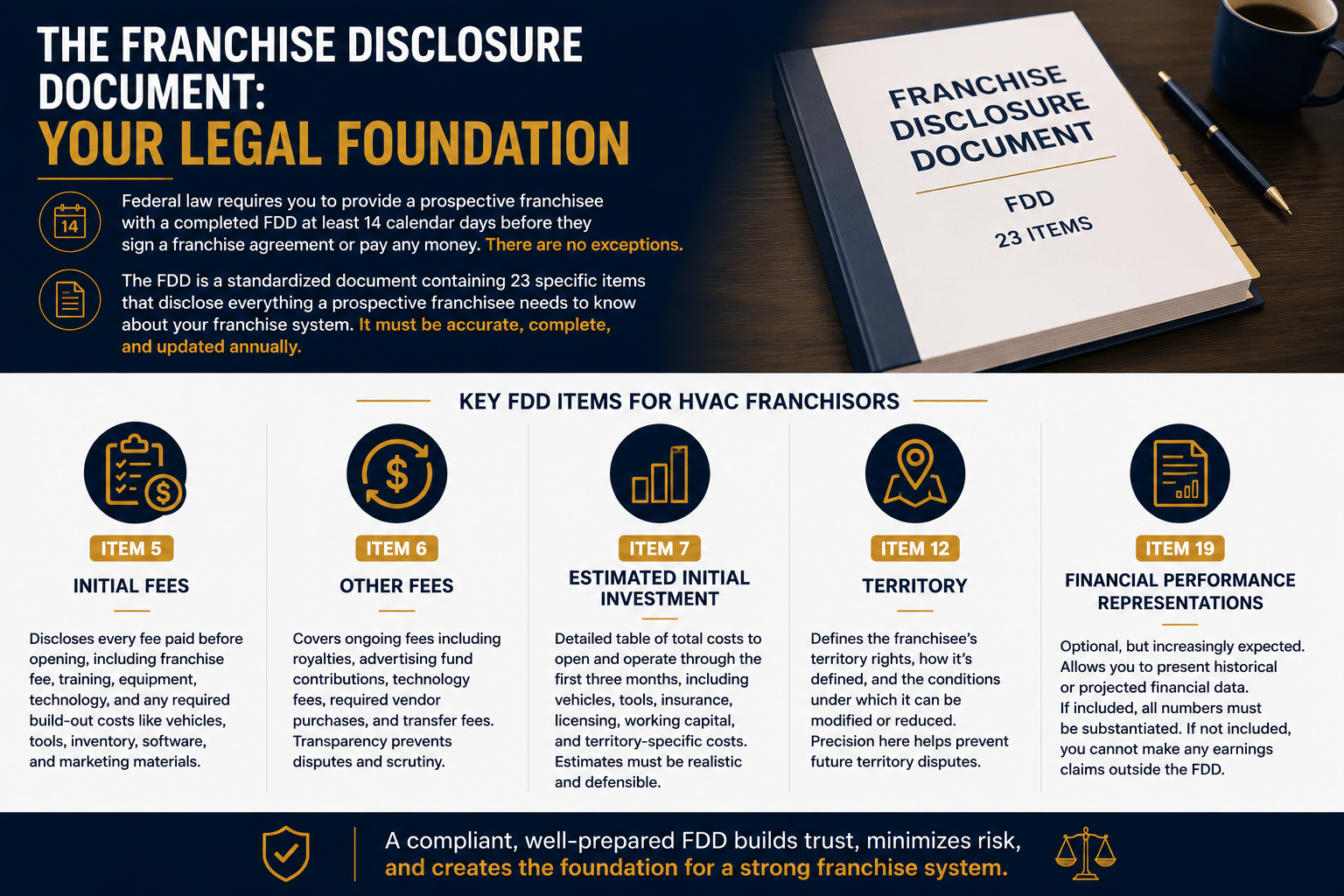
The franchise disclosure document (FDD) is the cornerstone of franchise law compliance. Federal law requires that you provide a prospective franchisee with a completed FDD at least 14 calendar days before they sign a franchise agreement or pay any money. There are no exceptions.
The FDD is a standardized document containing 23 specific items that disclose everything a prospective franchisee needs to know about your franchise system. FDD preparation is not a fill-in-the-blank exercise. It requires detailed financial disclosures, legal analysis, and operational documentation that must be accurate, complete, and updated annually.
Key FDD Items for HVAC Franchisors
While all 23 items matter, several are particularly important for HVAC franchise systems:
- Item 5: Initial Fees. This discloses every fee the franchisee pays before the business opens, including the initial franchise fee, training fees, equipment packages, technology fees, and any required build-out costs. For HVAC franchises, the initial investment typically includes vehicle wraps, diagnostic equipment, initial inventory, software licensing, and marketing materials.
- Item 6: Other Fees. This covers ongoing fees including royalties, advertising fund contributions, technology fees, required vendor purchases, and transfer fees. Transparency here is critical. Undisclosed fees are one of the most common sources of franchisee disputes and regulatory scrutiny.
- Item 7: Estimated Initial Investment. This provides a detailed table showing the total range of costs to open and operate the franchise through the first three months. For HVAC franchises, HVAC franchise cost estimates must include vehicles, tools, insurance, licensing, working capital, and any territory-specific costs. Your low and high estimates must be realistic and defensible.
- Item 12: Territory. This defines the franchisee’s franchise territory rights, including whether the territory is exclusive, how it is defined (by zip code, county, population, or geographic boundary), and under what conditions you can modify or reduce the territory. Territory disputes are among the most litigated issues in franchising, so precision here prevents future problems.
- Item 19: Financial Performance Representations. Item 19 FDD financial performance disclosure is optional, but it has become increasingly expected by prospective franchisees. If you include it, you can present historical or projected financial data for your company-owned or franchised locations. If you do not include it, you are prohibited from making any earnings claims outside the FDD. Many HVAC franchisors choose to include Item 19 because it helps close deals, but every number in it must be substantiated and documented.
The Franchise Agreement: Structuring the Relationship
While the FDD is a disclosure document, the franchise agreement is the binding contract that governs the relationship between you and each franchisee. Unlike a generic franchise agreement template, your agreement must be customized to the realities of the HVAC industry, including licensing requirements, technical certifications, seasonal revenue patterns, and the service-based nature of the business.
Franchise Fee Structure and Royalties
Your franchise fee structure has two primary components:
- Initial franchise fee. This is the upfront payment for the right to operate under your brand. For HVAC franchises, initial fees typically range from $25,000 to $75,000, depending on the territory size, the strength of the brand, and the level of support provided. The fee should reflect the genuine value of your training, systems, and brand equity, not just a number you think the market will bear.
- Ongoing royalties. The HVAC franchise royalty rate for most systems falls between 5% and 8% of gross revenue, with 6% being the most common in the home services sector. Some franchisors use a tiered royalty structure that decreases as the franchisee’s revenue grows, which incentivizes performance and reduces friction with high-performing operators. You will also typically collect a separate advertising fund contribution of 1% to 3% of gross revenue.
Key Contractual Provisions
- Term and renewal. Most HVAC franchise agreements run for 10 years with one or two renewal options. Renewal terms should specify any conditions (updated training, territory performance minimums, facility upgrades) and any fees.
- Performance standards. Define minimum revenue targets, customer satisfaction scores, response time requirements, and other operational benchmarks that franchisees must meet. These standards protect the brand and give you grounds for termination if a franchisee underperforms.
- Non-compete provisions. During the franchise term and for a defined period after termination or expiration (typically two years), franchisees should be restricted from operating or owning a competing HVAC business within their territory. These provisions protect your system but must comply with state-specific non-compete laws, which vary significantly.
- Transfer and assignment. Define the conditions under which a franchisee can sell their franchise to a third party, including your right of first refusal, approval criteria for the buyer, transfer fees, and training requirements for the new operator.
The Franchise Operations Manual
Your franchise operations manual is the playbook that ensures every franchisee delivers the same level of service under your brand. It is also a legally significant document because the FDD references it, and your ability to enforce system standards depends on having documented those standards in writing.
For an HVAC franchise system, the operations manual should cover:
- Service delivery standards. How technicians greet customers, how they conduct system assessments, how they present repair options and pricing, and how they follow up after service calls. Consistency in the customer experience is what separates a franchise from a group of independent operators using the same logo.
- Technical standards. Required equipment, diagnostic procedures, installation practices, refrigerant handling protocols, and quality control checklists. These standards protect the brand and reduce liability exposure across the system.
- Business operations. Dispatching protocols, CRM usage, invoicing procedures, maintenance agreement enrollment processes, inventory management, and financial reporting requirements. Your franchisees should not have to figure out how to run the business. The manual tells them.
- Hiring and training. Recruitment criteria, interview processes, onboarding protocols, ongoing training requirements, and standards for technician certifications. For HVAC franchises, this includes EPA 608 certification requirements, state-specific licensing, and manufacturer training programs.
- Marketing. Brand guidelines, approved marketing materials, local marketing requirements, social media policies, and procedures for requesting custom marketing assets. Protecting your intellectual property and brand consistency is one of the most important functions of the franchise relationship.
The operations manual is a living document. Build it with the expectation that it will be updated regularly as your system matures, technology changes, and franchisee feedback highlights areas for improvement.
State Franchise Registration Requirements
Federal law (the FTC Franchise Rule) applies everywhere, but state franchise registration requirements add another layer of compliance. Approximately 14 states require you to register your FDD with a state regulatory agency before you can offer or sell franchises to residents of that state. Several additional states have franchise relationship laws that regulate the ongoing franchisor-franchisee relationship, including termination and non-renewal rights.
Registration States
The states that require franchise registration include California, Hawaii, Illinois, Indiana, Maryland, Michigan, Minnesota, New York, North Dakota, Rhode Island, South Dakota, Virginia, Washington, and Wisconsin. Each state has its own registration process, fees, and review timeline.
California and New York have the most rigorous review processes and may take 60 to 90 days to approve your registration. Some states require you to escrow initial franchise fees until you have fulfilled your pre-opening obligations to the franchisee.
Filing States
Several additional states (Connecticut, Florida, Kentucky, Nebraska, Texas, and Utah) require a notice filing or exemption filing but do not conduct a substantive review of the FDD.
Ongoing Compliance
Registration is not a one-time event. You must renew your registration annually in every registration state, file amendments when material changes occur, and update your FDD within 120 days of your fiscal year-end. Franchise compliance requirements are ongoing and require disciplined legal and administrative processes.
Selling a franchise to a resident of a registration state without a current, approved registration is a violation that can result in the franchisee’s right to rescind the agreement and recover their entire investment, plus attorneys’ fees.
Many new franchisors underestimate the administrative burden of multi-state compliance. If you plan to offer franchises in 10 or more states, you should anticipate spending $15,000 to $30,000 annually on state registration renewals and amendments alone, not including legal fees. Building this cost into your franchise business plan from the beginning prevents surprises as your system grows.
HVAC Contractor License Considerations for Franchisees
One of the unique challenges of franchising in the HVAC industry is the HVAC contractor license franchise requirement. Unlike a fast food franchise where the franchisee does not need a professional license, HVAC franchisees (or their qualifying employees) must hold a valid HVAC contractor license in every state and municipality where they operate.
This creates several issues that must be addressed in your franchise system:
- Franchisee qualification. Your franchisee recruitment process must verify that the franchisee or a designated qualifying individual holds (or can obtain) the required contractor license before they begin operations. This may limit your pool of potential franchisees in some markets.
- License portability. Contractor licensing requirements vary by state. Some states have reciprocity agreements, while others require separate examinations and experience documentation. Your FDD and franchise agreement should clearly assign responsibility for obtaining and maintaining all required licenses to the franchisee.
- Regulatory risk. If a franchisee operates without proper licensing, the brand damage and potential liability to the franchisor can be significant. Your franchise agreement should include licensing compliance as a material obligation, with termination rights if the franchisee fails to maintain required licenses.
- Multi-state operations. If your franchise system spans multiple states, each franchisee may face different licensing requirements, continuing education mandates, and insurance minimums. Your operations manual should include a state-by-state licensing reference, and your compliance monitoring process should verify current license status at least quarterly. Some franchisors build license tracking into their required technology platform to automate this process.

What Does It Cost to Franchise Your HVAC Company?
Building a franchise system requires a meaningful upfront investment. Here is a realistic breakdown of the HVAC franchise cost to the franchisor:
- FDD preparation and legal fees. Working with a franchise disclosure document lawyer to prepare your initial FDD, franchise agreement, and related legal documents typically costs $30,000 to $75,000. This includes legal drafting, compliance review, and preparation of audited or reviewed financial statements.
- State registrations. Initial registration fees across all registration states total approximately $5,000 to $15,000. Annual renewals add ongoing costs.
- Operations manual development. If you do not have a comprehensive operations manual already, professional development can cost $10,000 to $30,000. Some franchisors develop the manual in-house, but it must be thorough enough to serve as both a training tool and a legal reference.
- Training program development. Building a structured training program for new franchisees, including classroom instruction and field training, typically costs $5,000 to $20,000 to develop initially.
- Franchise sales and marketing. Broker networks, franchise portals, trade shows, and sales materials to attract qualified franchisee candidates can cost $20,000 to $50,000 or more in the first year.
- Total initial investment for the franchisor typically ranges from $75,000 to $200,000 to properly launch a franchise system. Cutting corners on legal compliance or documentation to reduce this cost is a decision that almost always costs more in litigation and regulatory exposure than it saves.
Building Your Franchise Entity Structure
Before you begin offering franchises, you need to establish the right entity structure for your franchise operations. Most franchisors create a separate legal entity (typically an LLC or corporation) to serve as the franchisor entity, distinct from the operating company that runs your existing HVAC business.
This separation provides several benefits: it isolates the franchise operations from the risks of your existing business (and vice versa), it creates a clean structure for potential future investors or a sale of the franchise system, and it simplifies accounting and tax reporting.
Your franchisor entity will be the party that signs franchise agreements, owns the trademarks used in the franchise system, and receives royalty payments. The operating company typically provides services to the franchisor entity through an intercompany services agreement.
Work with your attorney and CPA to determine the optimal structure based on your tax situation, liability exposure, and long-term growth plans.
Protecting Your Brand
Your brand is the most valuable asset in your franchise system. Before you franchise, ensure that your company name, logo, and any proprietary trade names are properly registered as federal trademarks with the USPTO. Unregistered marks create significant risk: if you cannot enforce trademark rights, the entire foundation of the franchise relationship is compromised.
Beyond registration, your franchise agreement and operations manual should include detailed brand standards covering logo usage, color specifications, vehicle wrap designs, uniform requirements, signage specifications, and digital presence guidelines. Your franchise agreement checklist should include provisions for monitoring and enforcing brand compliance across all franchisees.
The Timeline: How Long Does It Take to Franchise a Business?
The process from deciding to franchise to awarding your first franchise typically takes 6 to 12 months:
- Months 1 to 2: Strategic assessment. Evaluate whether your business model is suitable for franchising. Engage a franchise attorney. Begin developing your franchise business plan.
- Months 2 to 4: FDD and legal document preparation. Your attorney drafts the FDD, franchise agreement, and related legal documents. You develop (or refine) your operations manual. Financial statements are prepared or audited as required.
- Months 4 to 5: State registrations. File your FDD in all registration states where you plan to offer franchises. Some states may require amendments or additional disclosures before approving your registration.
- Months 5 to 8: Franchise sales preparation. Develop your franchisee recruitment strategy, sales materials, and screening process. Begin marketing to prospective franchisees through broker networks, industry publications, and franchise portals.
- Months 8 to 12: First franchise sale. Provide the FDD to qualified candidates, observe the required 14-day waiting period, negotiate and execute the franchise agreement, and begin franchisee onboarding and training.
- The timeline can be compressed if you have strong existing documentation and a clear business model, or extended if significant operational development is needed before franchising. Rushing the legal compliance process to get to market faster is one of the most common and most costly mistakes new franchisors make.
When You Need a Franchise Attorney
Franchising is one of the most regulated areas of business law. The cost of non-compliance is not a fine. It is the potential unwinding of every franchise agreement you have signed, plus damages. You need experienced legal counsel at every stage:
- FDD preparation and annual updates to ensure compliance with the FTC Franchise Rule and all applicable state laws
- Franchise agreement drafting that protects your interests while remaining fair and enforceable
- State registration filings and ongoing compliance in all registration and filing states
- Trademark registration and enforcement to protect the brand assets that anchor your franchise system
- Franchisee disputes, including termination, non-renewal, breach claims, and territory disputes
- Ongoing compliance counsel as your system grows, including unit economics review, disclosure updates, and relationship management
At Next Era Legal, we serve as fractional general counsel for home services companies that are scaling through franchising, licensing, and multi-location expansion. The franchise attorney cost of working with experienced counsel is a fraction of what you will spend unwinding a franchise system that was built on a non-compliant foundation.
Understanding the legal requirements is not optional. It is the foundation that everything else is built on. If you are ready to franchise your HVAC company, start with the legal roadmap, and build from there.
Ready to explore franchising your HVAC business? Schedule a Consultation
Frequently Asked Questions
How much does it cost to franchise an HVAC company?
The total franchisor investment to launch a compliant franchise system typically ranges from $75,000 to $200,000. This includes FDD preparation ($30,000 to $75,000), state registration fees ($5,000 to $15,000), operations manual development ($10,000 to $30,000), training program development ($5,000 to $20,000), and franchise sales and marketing costs. Cutting corners on legal compliance to reduce costs almost always results in greater expense down the road.
How long does it take to franchise a business?
The process from initial decision to awarding your first franchise typically takes 6 to 12 months. The legal documentation (FDD, franchise agreement, state registrations) accounts for the first 4 to 5 months. Franchise sales preparation and the first franchisee recruitment cycle account for the remainder. The timeline depends on the complexity of your business model and whether your existing documentation and operations manual are already well-developed.
What is the typical HVAC franchise royalty rate?
Most HVAC franchise systems charge ongoing royalties of 5% to 8% of gross revenue, with 6% being the most common in the home services sector. Franchisees also typically contribute 1% to 3% of gross revenue to a system advertising fund. Some franchisors use tiered royalty structures that decrease as the franchisee’s revenue grows.
Do I need to register in every state to sell franchises?
No. Only about 14 states require franchise registration before you can offer or sell franchises to their residents. However, the FTC Franchise Rule applies nationwide, so you must provide a compliant FDD to every prospective franchisee regardless of location. Several additional states require notice filings. Selling a franchise in a registration state without approval can give the franchisee the right to rescind the agreement and recover their full investment.
What is the difference between a franchise and a license for an HVAC business?
A franchise exists when three elements are present: use of the franchisor’s trademark, significant control or assistance over operations, and a required fee. A license typically involves less control and fewer ongoing obligations. If your business model involves branded operations, standardized procedures, and ongoing royalties, it is almost certainly a franchise under the law, regardless of what you label it. Misclassifying a franchise as a license to avoid compliance is a serious legal risk.
Can my franchisees use my HVAC contractor license?
No. Contractor licenses are not transferable between businesses. Each franchisee must independently hold (or employ someone who holds) a valid HVAC contractor license in every jurisdiction where they operate. Your franchise system should include a verification process during franchisee recruitment and ongoing compliance monitoring as part of your franchise compliance requirements.
Disclaimer
All information is for educational purposes only and does not constitute legal advice or form an attorney-client relationship.