

Buying an HVAC business is one of the most reliable paths into a recession-resistant, high-margin industry. Heating and cooling companies generate recurring revenue through maintenance agreements, operate in a market driven by equipment replacement cycles and new construction, and benefit from regulatory complexity that creates natural barriers to entry. It is no surprise that private equity firms, search fund operators, and independent buyers are actively pursuing HVAC acquisitions across the country.
But the same characteristics that make HVAC companies attractive also make them legally complex to acquire. Contractor licenses are often tied to individuals rather than entities. Maintenance contracts frequently contain anti-assignment clauses that can void your most valuable revenue stream at closing. Technician retention, EPA compliance, refrigerant handling certifications, fleet condition, and customer concentration all present risks that a standard business acquisition checklist will miss entirely.
If you are trying to figure out how to buy an HVAC business the right way, this guide covers every phase, from initial evaluation and valuation through deal structure, due diligence, and closing. It is written from the legal and financial perspective that most broker-driven guides overlook, because the legal decisions you make during the acquisition process will determine whether you are buying a profitable business or inheriting a liability.
Why HVAC Is One of the Most Attractive Acquisition Targets
Before diving into the mechanics, it is worth understanding why HVAC businesses command the multiples they do. Buyers are not just purchasing revenue. They are purchasing several structural advantages that make HVAC companies uniquely valuable.
First, demand is non-discretionary. When a furnace fails in January or an air conditioning unit stops working in August, the homeowner calls immediately. This creates a base of emergency service revenue that persists regardless of economic conditions.
Second, the industry generates strong recurring revenue through preventive maintenance agreements. A well-run HVAC company with 1,500 to 3,000 active maintenance contracts produces predictable, high-margin cash flow every month. That recurring revenue base is the single most important driver of valuation multiples.
Third, HVAC businesses benefit from an aging equipment cycle. The average residential HVAC system has a 15 to 20 year lifespan. As systems installed during the housing boom of the early 2000s age out, replacement demand continues to grow.
Finally, regulatory complexity around refrigerant handling (EPA Section 608), building codes, and contractor licensing requirements creates barriers to entry that protect established operators from casual competition.
These factors explain why HVAC business profit margins for well-run companies typically range from 15% to 25% on service work and 8% to 15% on installation, and why private equity has been so aggressively pursuing roll-up strategies in the sector.
How Much Does an HVAC Business Cost?
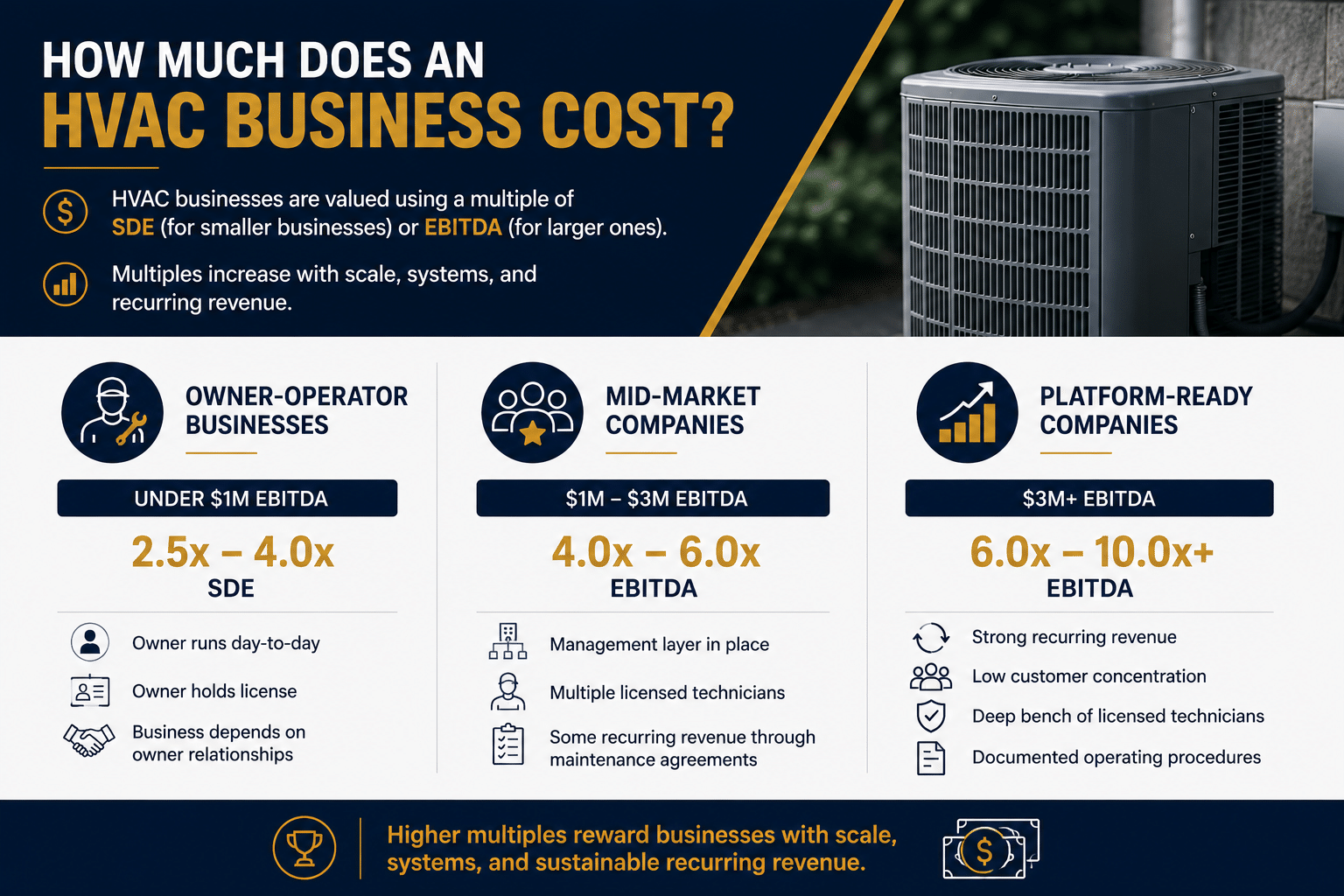
HVAC business valuations are typically expressed as a multiple of either Seller’s Discretionary Earnings (SDE) for smaller companies or EBITDA for larger operations. Understanding these multiples is essential before you begin evaluating opportunities.
HVAC Valuation Multiples by Business Size
- Owner-operator businesses (under $1M EBITDA) generally trade at 2.5x to 4.0x SDE. These are companies where the owner is actively running day-to-day operations, often holding the contractor license personally, and the business depends heavily on the owner’s relationships and presence.
- Mid-market companies ($1M to $3M EBITDA) trade at 4.0x to 6.0x EBITDA. These businesses typically have a management layer, multiple licensed technicians, and some recurring revenue through maintenance agreements.
- Platform-ready companies ($3M+ EBITDA) can command 6.0x to 10.0x or higher, particularly when they have strong recurring revenue, low customer concentration, a deep bench of licensed technicians, and documented operating procedures. These are the companies private equity firms are paying premium multiples to acquire as platforms for further roll-up.
What Drives the Multiple Up or Down
Several factors determine where within these ranges a specific HVAC company will be valued:
- Recurring revenue mix is the single biggest premium driver. A company with 30% or more of revenue coming from maintenance agreements will trade at a significantly higher multiple than one dependent entirely on one-time installation and emergency service calls. Maintenance contracts produce predictable revenue, higher margins, and a built-in customer base for upselling equipment replacements.
- Customer concentration is the most common value killer. If your top 10 customers represent more than 35% of revenue, buyers will apply a discount. If a single customer accounts for more than 15%, expect a material adjustment. In commercial HVAC, this is especially common with property management companies and general contractors.
- Technician retention and depth directly affects the buyer’s confidence that the business will perform post-closing. A company where multiple EPA-certified technicians have been employed for three or more years presents far less risk than one where the owner and one senior technician handle 80% of the work.
- Revenue mix between new construction and service matters significantly. New construction revenue is project-based, cyclical, and lower-margin. Service and replacement revenue is more stable and higher-margin. Companies with a heavy new construction skew (70% or more) typically trade at the bottom of the multiple range.
- Owner dependence is the factor that catches first-time buyers most often. If the business cannot operate profitably for 90 days without the current owner, the transition risk is high and the multiple should reflect that.
Deal Structure: Asset Purchase vs. Stock Purchase
The question of asset purchase vs. stock purchase is one of the most consequential legal decisions in any HVAC acquisition. This decision affects your tax position, your liability exposure, and the complexity of the post-closing transition.
Asset Purchase
In an asset purchase, you are buying specific assets of the business: equipment, vehicles, customer lists, inventory, intellectual property, and the right to operate under the business name. You are not buying the legal entity itself.
- Advantages for buyers: You can select which assets to acquire and which liabilities to leave behind. You get a “stepped-up” tax basis on the acquired assets, allowing you to depreciate them at their purchase price rather than their historical book value. This typically produces significant tax savings over the first five to seven years of ownership. You also avoid inheriting unknown liabilities: pending lawsuits, tax disputes, environmental issues, or warranty claims that predate the acquisition.
- Complications for HVAC buyers: Asset purchases require the assignment or re-execution of every customer contract, vendor agreement, and maintenance contract. In HVAC, this can be hundreds or thousands of individual agreements. Many maintenance contracts contain anti-assignment clauses that require customer consent before the contract can be transferred. If consent is not obtained, you may lose the very recurring revenue base you paid a premium to acquire.
Additionally, contractor licenses cannot be “purchased” as assets. If the seller’s contractor license is held individually, you will need to ensure that you or an employee hold the appropriate license in every jurisdiction where the company operates before closing.
Stock Purchase
In a stock purchase, you are buying the ownership interest in the legal entity itself. The entity continues to exist with all of its contracts, licenses, assets, and liabilities intact. You simply become the new owner.
- Advantages for HVAC buyers: Contracts, permits, and licenses held by the entity transfer automatically because the entity itself does not change. This eliminates the need to obtain individual consent from hundreds of maintenance contract customers. Vendor relationships, insurance policies, and bonding all continue without interruption.
- Risks for buyers: You inherit everything, including liabilities you may not know about. If the company has an unresolved EPA violation, a pending discrimination claim, or unpaid payroll taxes, those become your problems at closing. This is why due diligence is substantially more intensive in a stock purchase.
Which Structure Is Right?
Most HVAC acquisitions are structured as asset purchases, primarily for the tax advantages and liability protection they offer buyers. However, if the target company has a large base of maintenance contracts with anti-assignment clauses, or if its contractor license is held at the entity level in a way that would be lost in an asset purchase, a stock purchase may be the better option despite the additional risk.
Your attorney and CPA should evaluate this decision together early in the process, because the deal structure affects everything that follows: the purchase agreement, the due diligence scope, the tax treatment, and the transition plan.
HVAC Acquisition Due Diligence: What to Review Before You Close
Due diligence for an HVAC acquisition goes well beyond reviewing financial statements. The industry has specific legal, regulatory, and operational risks that require targeted investigation. What follows is a framework for the areas that matter most.
Financial Due Diligence
Start with at least three years of income statements, balance sheets, and tax returns. Reconcile reported revenue against bank deposits to verify that cash revenue is accurately stated. HVAC businesses, particularly those with a residential focus, sometimes have cash revenue that is not fully captured in financial reporting.
Request a quality of earnings analysis if the acquisition is above $1M in purchase price. A QoE report, typically prepared by a CPA firm, normalizes the financials by removing one-time expenses, owner perks, and non-recurring items to show the true earning power of the business. Private equity buyers require a QoE on virtually every deal, and independent buyers should consider one for any acquisition above the SBA lending threshold.
Break revenue down by category: maintenance agreements, emergency service calls, equipment replacement, new installation, and commercial vs. residential. This tells you where the revenue comes from, how stable it is, and where the growth opportunities lie.
Licensing and Regulatory Compliance
This is the area where HVAC acquisitions diverge most sharply from general business acquisitions.
- Contractor licensing: Verify that the business holds all required contractor licenses in every jurisdiction where it operates. Determine whether the license is held by the entity or by an individual. If it is held by the owner personally, you will need a plan for licensing continuity post-closing, which may mean hiring a qualifying individual or obtaining your own license before the deal closes.
- EPA 608 certification: Every technician who handles refrigerants must hold an EPA Section 608 certification. Request a list of all technicians and their certification levels (Type I, II, III, or Universal). Confirm that certifications are current and that the company has been maintaining proper refrigerant tracking logs as required by EPA regulations.
- OSHA compliance: Request the company’s OSHA 300 logs for the past three years. Review for patterns of workplace injuries, particularly falls from ladders or roofs, electrical injuries, and refrigerant exposure incidents. A poor safety record increases your workers’ compensation premiums and signals potential OSHA enforcement risk.
Contract and Customer Review
Request copies of every customer contract, maintenance agreement, and vendor agreement. Focus on:
- Anti-assignment clauses: Determine which contracts require customer or vendor consent for assignment. If the deal is structured as an asset purchase, you need to build a consent solicitation plan into the pre-closing timeline.
- Auto-renewal terms: Understand when maintenance contracts renew and whether there are termination windows that customers could exercise during the ownership transition.
- Warranty obligations: Equipment warranties are manufacturer-backed, but labor warranties are the contractor’s liability. Review the company’s standard warranty terms and estimate the potential cost of honoring existing warranty commitments post-closing.
- Customer concentration: Build a revenue-by-customer analysis for the top 20 accounts. If any single customer represents more than 10% of revenue, or the top 10 represent more than 35%, factor that concentration risk into your valuation.
Workforce and Personnel
Review employment agreements, compensation structures, and benefit programs for all employees. Pay particular attention to:
- Technician certifications and licensing: Confirm that all technicians hold the certifications required for their work. If the company operates in a state that requires individual technician licensing, verify compliance.
- Confidentiality agreements: Determine whether key technicians and salespeople have signed confidentiality agreements protecting customer lists, pricing structures, and proprietary service processes. If they have not, there is a risk that departing employees could take customer relationships and operational knowledge with them. Non-compete agreements have become largely unenforceable in most states, making confidentiality and non-solicitation agreements the more reliable tools for protecting the business post-closing.
- Employee vs. independent contractor classification: HVAC companies frequently use 1099 subcontractors for installation work. Review the classification of all workers to assess misclassification risk. The IRS and state departments of labor are actively auditing the construction and home services sector for worker misclassification, and the penalties for getting this wrong include back taxes, benefits, and fines that can reach six figures. For a deeper breakdown of this issue and how to evaluate your risk, download our free guide: 1099 vs. W-2 Classification Guide for Contractors.
Physical Assets and Fleet
Inspect all vehicles, equipment, and tools included in the sale. Verify vehicle titles, odometer readings, and maintenance records. Assess the remaining useful life of major equipment (recovery machines, vacuum pumps, diagnostic tools, etc.). Confirm that vehicles meet local emission and safety standards.
For companies with a parts inventory, conduct a physical count and compare against the balance sheet. Write down obsolete or slow-moving parts. If the company stocks refrigerants, verify that all cylinders are properly labeled and stored in compliance with EPA regulations.
Environmental and Insurance Review
Request copies of all insurance policies, including general liability, workers’ compensation, commercial auto, and professional liability. Verify coverage levels and review claims history for the past five years.
Assess environmental exposure related to refrigerant handling, lead paint (for companies that work on older buildings), and asbestos (for companies that service legacy HVAC systems). These liabilities can be significant and may not appear on the balance sheet. Proper asset protection planning before closing can help shield you from inheriting environmental exposure that was not adequately disclosed.

The SBA Loan Path: Financing Your HVAC Acquisition
Many independent buyers finance HVAC acquisitions through SBA 7(a) loans. The SBA lending program is specifically designed for business acquisitions and offers several advantages: lower down payments (typically 10% to 20%), longer repayment terms (up to 10 years for business acquisitions), and competitive interest rates.
However, SBA lenders have specific requirements for acquisition financing that affect how the deal is structured:
- Full-standby seller notes: If the seller is providing financing beyond the buyer’s equity and SBA loan, the SBA typically requires that the seller note be on full standby for at least 24 months, meaning no payments are made on the seller note until the SBA loan is seasoned.
- Equity injection requirements: The buyer must contribute a minimum equity injection, typically 10% to 20% of the total project cost. Gift funds and borrowed funds generally do not qualify.
- Business valuation: The SBA requires an independent business valuation for acquisitions above a certain threshold. This valuation must support the purchase price and must be conducted by a qualified appraiser.
- Change of ownership requirements: The SBA will require proof that all necessary licenses, permits, and regulatory approvals will transfer or be obtained by the buyer prior to or at closing.
Working with a lender experienced in SBA acquisition financing, alongside your attorney, ensures that the deal structure satisfies both the SBA requirements and the legal protections you need.
The Letter of Intent and Purchase Agreement
Once you have identified a target, completed preliminary due diligence, and agreed on a price and general terms, the next step is a letter of intent.
The Letter of Intent (LOI)
The LOI outlines the key deal terms: purchase price, deal structure (asset vs. stock), what is included and excluded, earnout provisions if any, the due diligence period, exclusivity terms, and the expected closing timeline.
While most LOIs are non-binding on the substantive terms, the exclusivity provision (which prevents the seller from negotiating with other buyers during due diligence) is typically binding. Your attorney should draft or review the LOI to ensure that the exclusivity period is long enough to complete diligence and that any binding provisions are terms you are comfortable committing to.
The Asset Purchase Agreement or Stock Purchase Agreement
The purchase agreement is the definitive legal document that governs the transaction. Whether it is an asset purchase agreement or a stock purchase agreement, it should address:
- Representations and warranties: These are the seller’s formal statements about the condition of the business. They cover everything from financial accuracy and tax compliance to the enforceability of contracts, the absence of undisclosed liabilities, and compliance with environmental regulations. The breadth and specificity of these representations are your primary legal protection against discovering problems after closing.
- Indemnification provisions: Indemnification determines who pays if a representation turns out to be false or if a pre-closing liability surfaces after the deal closes. Negotiate the indemnification cap, the survival period (how long after closing you can make a claim), and the basket or deductible amount carefully. These provisions are where many acquisitions are won or lost after the fact.
- Non-compete and non-solicitation agreements: The seller should agree not to compete with the business and not to solicit its employees or customers for a defined period after closing. In HVAC, a three to five year non-compete with a geographic radius that covers the company’s service territory is standard.
- Transition services: If the seller is staying on for a transition period, define the scope, duration, compensation, and termination provisions clearly. Ambiguity in transition arrangements is one of the most common sources of post-closing disputes.
- Closing conditions: These are the requirements that must be satisfied before the deal can close. Common conditions include completion of due diligence, lender approval, license transfer or issuance, landlord consent to lease assignment, and receipt of any required customer consents for contract assignment.
Post-Closing: The First 90 Days
Closing the deal is not the finish line. The first 90 days of ownership determine whether the value you purchased actually transfers.
- Licensing continuity: If you have not already obtained your own contractor license, ensure that the qualifying individual is in place and that all jurisdictional requirements are satisfied before the seller departs.
- Customer communication: Notify maintenance contract customers of the ownership change. Frame the communication around continuity: same technicians, same service standards, same phone number. Retention during the transition window is critical.
- Technician retention: Meet individually with every technician and key employee within the first two weeks. Confirm compensation, benefits, and advancement opportunities. The single biggest risk in any HVAC acquisition is losing the technicians who hold the customer relationships and the technical knowledge.
- Vendor and supplier relationships: Introduce yourself to key suppliers and re-establish credit terms. If the previous owner had personal guarantees on supply accounts, those may need to be replaced.
- Insurance and bonding: Transfer or obtain new insurance policies and performance bonds effective as of the closing date. Do not operate even one day without proper coverage.
Is Buying an HVAC Business a Good Investment?
For buyers who do their homework, the answer is almost always yes. HVAC businesses offer a combination of recession resistance, recurring revenue, strong margins, and growing demand that is difficult to find in most other industries.
The risk is not in the industry. The risk is in the acquisition process itself: overpaying for a business with hidden problems, inheriting liabilities that were not identified during diligence, losing key technicians during the transition, or structuring the deal in a way that creates unnecessary tax burden or legal exposure.
The buyers who succeed are the ones who treat the acquisition like the six- or seven-figure investment it is. They hire the right advisors, conduct thorough due diligence, and build a legal framework that protects their investment from day one. Business succession planning from the buyer’s perspective starts at closing: building the systems, team, and documentation that will allow you to eventually exit on your own terms.
When You Need a Lawyer
You can research valuations, tour the facilities, meet the technicians, and review the financials on your own. But several aspects of buying an HVAC business require legal expertise:
- Deal structure analysis (asset vs. stock) with your CPA to optimize tax treatment and minimize liability exposure
- LOI and purchase agreement drafting and negotiation, including representations, warranties, indemnification, and non-compete provisions
- Due diligence review of contracts, licenses, employment agreements, and regulatory compliance
- Contractor license transfer strategy and compliance with state-specific requirements
- SBA loan coordination to ensure the deal structure satisfies lender requirements
- Post-closing transition planning, including employee retention agreements and customer notification strategy
At Next Era Legal, we serve as fractional general counsel for contractors and home services businesses nationwide. We have guided buyers through HVAC acquisitions ranging from single-location residential operators to multi-state commercial platforms. Our approach is not to hand you a template and wish you luck. We embed in the deal from LOI through closing and stay engaged through the transition to protect your investment.
Ready to explore an HVAC acquisition? Schedule a Consultation
Frequently Asked Questions
How much does it cost to buy an HVAC business?
Purchase prices range widely based on size and profitability. Small owner-operator businesses typically sell for $200,000 to $750,000, while mid-market companies with $1M+ in EBITDA can range from $3M to $10M or more. Valuation multiples of 2.5x to 6.0x SDE or EBITDA are standard, with premiums for strong recurring revenue, low customer concentration, and a deep technician bench.
Should I use an asset purchase or stock purchase to buy an HVAC company?
Most HVAC acquisitions are structured as asset purchases because they offer tax advantages (stepped-up basis) and allow the buyer to avoid inheriting unknown liabilities. However, if the target company has a large maintenance contract base with anti-assignment clauses, a stock purchase may be preferable because contracts transfer automatically with the entity. Your attorney and CPA should evaluate both structures based on your specific deal.
What licenses do I need to buy an HVAC business?
Requirements vary by state, but you will generally need a valid HVAC contractor license in every jurisdiction where the business operates. In most states, this license is tied to a qualifying individual (not the business entity), so you will need either your own license or a licensed employee before the current owner leaves. Your due diligence should identify every required license and your closing conditions should include a licensing continuity plan.
Can I finance an HVAC acquisition with an SBA loan?
Yes. SBA 7(a) loans are commonly used for HVAC business acquisitions. They typically require 10% to 20% equity injection from the buyer, offer repayment terms up to 10 years, and require an independent business valuation. The deal structure must satisfy the SBA’s requirements, including full-standby provisions for any seller financing. Working with an SBA-experienced lender and attorney ensures the deal is structured correctly.
How long does it take to close an HVAC acquisition?
From signed LOI to closing, most HVAC acquisitions take 60 to 120 days. The timeline depends on the complexity of the due diligence, the deal structure, lender processing time (if SBA-financed), and the time needed to transfer or obtain contractor licenses. Asset purchases with large maintenance contract bases may take longer due to the customer consent process.
What is the biggest risk when buying an HVAC business?
The biggest risk is typically a combination of owner dependence and technician retention. If the current owner is the primary customer relationship holder and the lead technician, and key technicians leave during the transition, you can lose both the operational capacity and the customer relationships that drove the valuation. Thorough workforce diligence and structured transition planning mitigate this risk.
Disclaimer
All information is for educational purposes only and does not constitute legal advice or form an attorney-client relationship.