



The legal status of BPC-157 has shifted more in the past 18 months than in the previous decade. Between the FDA’s Category 2 classification, the February 2026 reclassification announcement from HHS Secretary Robert F. Kennedy Jr., the April 2026 removal from Category 2, and the July 2026 PCAC advisory vote, providers and clinic owners are operating in one of the most rapidly evolving regulatory environments in modern pharmaceutical law.
For physicians prescribing peptide therapies, clinic owners building practices around regenerative medicine, and compounding pharmacies navigating FDA enforcement, understanding exactly where BPC-157 stands legally is not optional. Getting this wrong exposes you to FDA warning letters, state medical board investigations, malpractice liability, and potential criminal prosecution.
This guide breaks down the current BPC-157 legal status, what each regulatory milestone actually means, and the compliance steps that providers and clinics must follow to operate lawfully.
What Is BPC-157 and Why Does Its Legal Status Matter
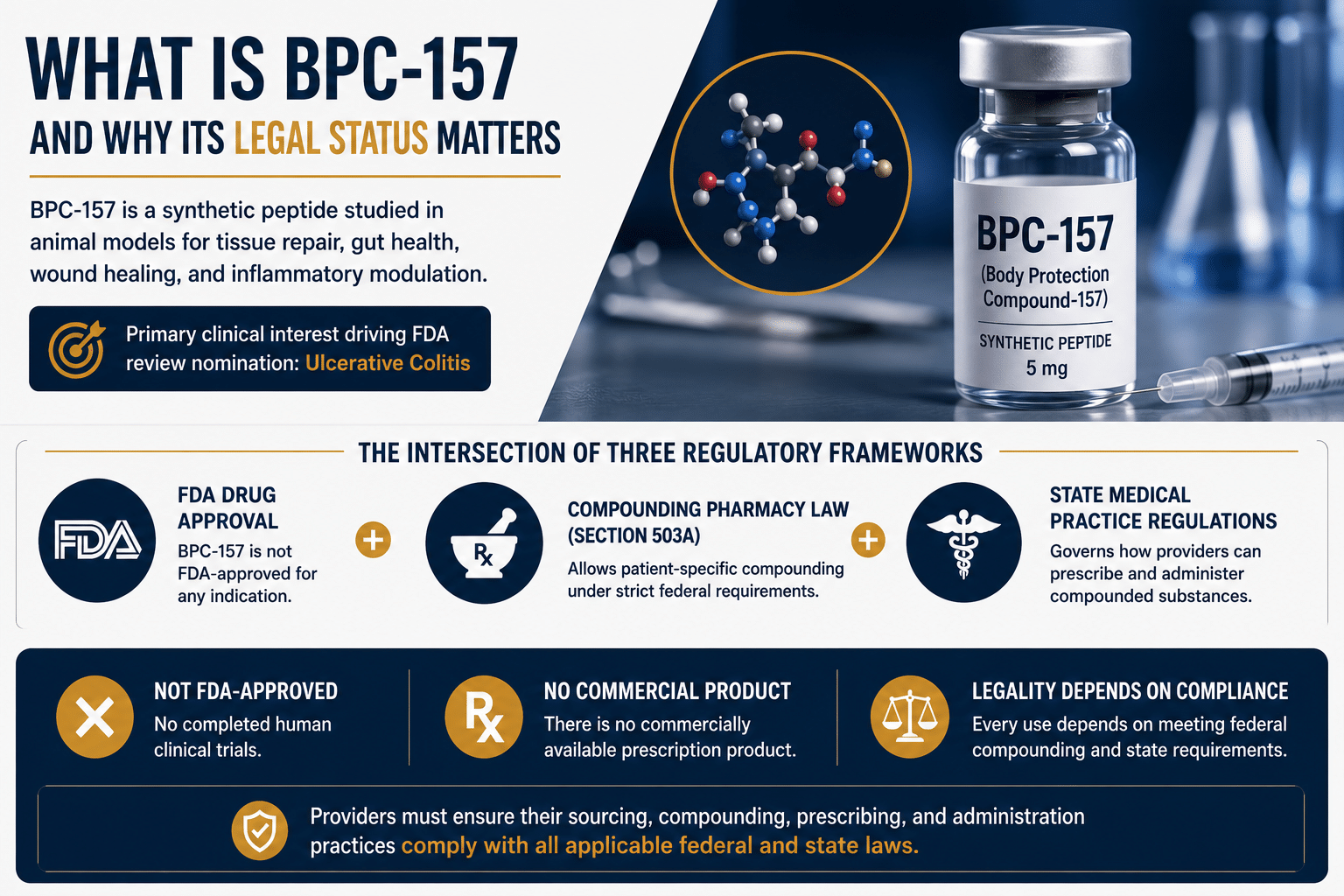
BPC-157 (Body Protection Compound-157) is a synthetic peptide derived from a protein found in human gastric juice. It has been studied extensively in animal models for its effects on tissue repair, wound healing, gut mucosal protection, and inflammatory modulation. The clinical interest driving its nomination for FDA review is primarily Ulcerative Colitis, though providers in regenerative medicine and sports medicine have used it for a broader range of applications. The reason the BPC-157 legal status matters so much is that it sits at the intersection of three regulatory frameworks: FDA drug approval, compounding pharmacy law under Section 503A of the Federal Food, Drug, and Cosmetic Act, and state medical practice regulations. A provider’s legal exposure depends on which framework applies and how they source, prescribe, and administer the peptide. BPC-157 is not FDA-approved for any indication. It has no completed human clinical trials. There is no commercially available prescription product. This means that every clinical use of BPC-157 exists outside the standard drug approval pathway, and the legality of that use depends entirely on whether the compounding and prescribing pathway meets federal and state requirements.
The FDA Category 2 Classification: What It Meant
In late 2023, the FDA placed BPC-157 on its Category 2 list of bulk drug substances under the 503A framework. Category 2 substances are those the FDA has identified as raising “significant safety concerns,” including risks related to immunogenicity, peptide-related impurities, and insufficient safety data.What Category 2 Actually Prohibited
The practical effect of the Category 2 designation was significant. Licensed compounding pharmacies under Section 503A could no longer legally compound BPC-157 for individual patients with a physician’s prescription. The 503A Bulks List is the only legal pathway for compounding pharmacies to prepare substances that are not components of FDA-approved drugs and do not have a USP monograph. When BPC-157 was placed in Category 2, that pathway closed. This did not make BPC-157 illegal to possess or study. It remained available for Research Use Only (RUO). But the distinction between research use and clinical use is where most providers ran into legal trouble. The FDA views prescribing, reconstituting, or administering RUO peptides to humans as the misbranding and distribution of unapproved new drugs. This is not a gray area. It is the basis for the more than 50 warning letters the FDA issued to compounders, online sellers, and clinics between late 2024 and early 2026.The February 2026 Reclassification Announcement
On February 27, 2026, HHS Secretary Robert F. Kennedy Jr. announced that approximately 14 of the 19 restricted peptides, including BPC-157, would be considered for reclassification from Category 2 back to Category 1 status. This announcement signaled a major policy shift and generated significant attention from the peptide therapy community.What the Announcement Did and Did Not Do
The announcement was a policy direction, not a regulatory action. It did not immediately change the legal status of BPC-157. It indicated that the administration intended to restore the legal pathway for compounding pharmacies to prepare these peptides, but the actual regulatory process required formal steps that had not yet occurred. Providers who interpreted the announcement as immediate authorization to begin compounding or prescribing BPC-157 were wrong, and several faced enforcement actions in the weeks that followed. The FDA continued issuing warning letters throughout March and April 2026, including seven letters to online peptide sellers in April alone. This distinction matters for highly regulated businesses operating in the peptide space. A policy announcement from HHS is not the same as a final rule from the FDA, and acting on the former before the latter is finalized creates real legal exposure.The April 2026 Category 2 Removal
On April 22, 2026, the FDA formally removed BPC-157 from the Category 2 list. This was the first concrete regulatory action following the February announcement and represented a meaningful step toward restoring the compounding pathway.What Removal from Category 2 Means
Removal from Category 2 eliminates the FDA’s formal designation of BPC-157 as a substance with significant safety concerns for compounding purposes. However, removal from Category 2 is not the same as addition to the Category 1 Bulks List. It removes a barrier, but it does not affirmatively authorize compounding. For a substance to be legally compounded under Section 503A, it must either be a component of an FDA-approved drug, have a USP monograph, or appear on the 503A positive Bulks List. After the Category 2 removal, BPC-157 met none of these criteria. The regulatory status was improved but not resolved. Compounding pharmacies that resumed preparation of BPC-157 after the Category 2 removal were operating in a legal gray zone. Some did so under the theory that the removal of the negative designation, combined with the PCAC review process, provided sufficient regulatory cover. Whether that theory will hold up under FDA scrutiny remains to be seen. Providers should consult with a regulatory compliance attorney before making sourcing decisions based on this interpretation.The July 2026 PCAC Vote
The Pharmacy Compounding Advisory Committee (PCAC) met on July 23-24, 2026, at the FDA White Oak Campus to formally review BPC-157 along with six other peptides: TB-500, KPV, MOTS-c, Semax, Epitalon, and DSIP.The Vote Results
The PCAC voted 8-6 to recommend that BPC-157 be added to the 503A positive Bulks List. Six of the seven peptides reviewed received favorable recommendations. Only DSIP was rejected. The vote was notable because it contradicted the FDA’s own staff recommendation. The FDA’s briefing documents had recommended against adding any of the seven peptides to the Bulks List. The committee disagreed on six of seven.What the PCAC Vote Does Not Do
A positive PCAC recommendation is advisory. It is not FDA approval, and it does not immediately authorize compounding. The recommendation initiates a formal rulemaking process that includes a Notice of Proposed Rulemaking, a public comment period, and a final rule. This process typically takes additional months to complete. Until the final rule is published, BPC-157 is not on the 503A Bulks List, and the legal pathway for compounding remains incomplete. Providers who understand the importance of proper entity structuring and compliance infrastructure recognize that building a practice around a substance before its regulatory status is finalized carries meaningful risk.Current Legal Status: Where BPC-157 Stands Right Now
As of July 2026, the BPC-157 legal status can be summarized as follows:- Not FDA-approved. BPC-157 is not approved for any indication. There is no commercially available prescription product.
- Removed from Category 2. The FDA’s formal designation of BPC-157 as a substance with significant safety concerns has been withdrawn.
- PCAC recommendation pending final rule. The advisory committee has recommended addition to the 503A Bulks List, but the formal rulemaking process is not complete.
- Research Use Only remains legal. BPC-157 can be legally purchased, possessed, and used for legitimate research purposes.
- Clinical use remains legally uncertain. Prescribing, compounding, and administering BPC-157 to patients exists in a regulatory gap. The Category 2 barrier has been removed, but the affirmative authorization has not been finalized.
Enforcement Landscape: What the FDA Is Actually Doing
The FDA’s enforcement posture on peptides has been aggressive and is not slowing down despite the reclassification process.Warning Letters and Criminal Referrals
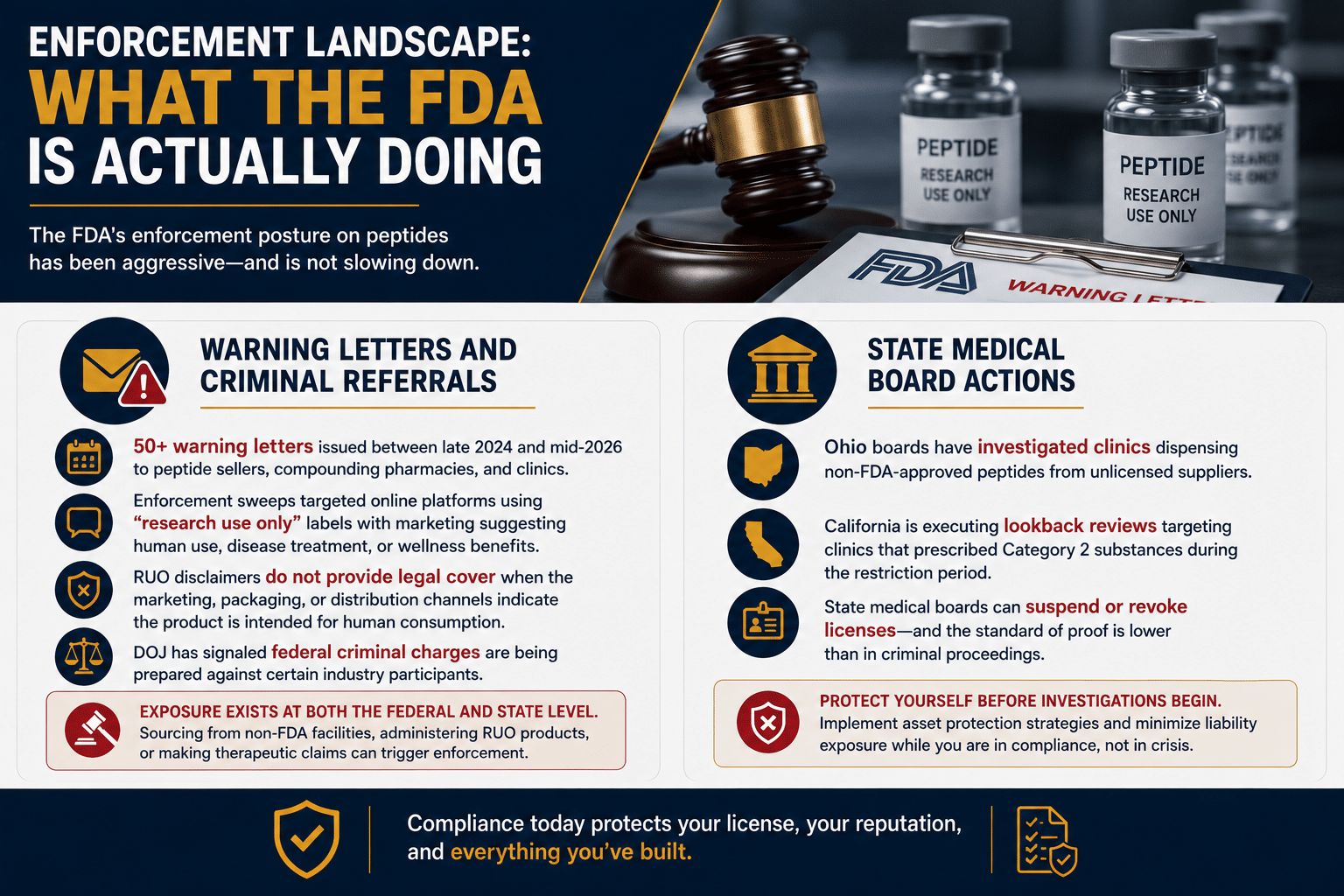
Between late 2024 and mid-2026, the FDA issued more than 50 warning letters to peptide sellers, compounding pharmacies, and clinics. The March and April 2026 enforcement sweeps targeted online platforms selling peptides with “research use only” labels that included marketing language suggesting human use, disease treatment claims, or wellness benefits. The FDA has made clear that RUO disclaimers do not provide legal cover when the surrounding marketing, packaging, or distribution channels indicate the product is intended for human consumption. Beyond warning letters, the Department of Justice has signaled that federal criminal charges are being prepared against certain peptide industry participants. Clinics that source peptides from non-FDA-registered facilities, administer RUO products to patients, or make therapeutic claims without proper regulatory authorization face exposure at both the federal and state level.State Medical Board Actions
State enforcement is intensifying in parallel. Ohio’s medical and pharmacy boards initiated investigations into clinics dispensing non-FDA-approved peptides from unlicensed suppliers. California is executing lookback reviews targeting clinics that prescribed Category 2 substances during the restriction period. State medical boards can suspend or revoke medical licenses, and the standard of proof is lower than in criminal proceedings. Providers need proper asset protection strategies in place before a board investigation begins, not after. The time to structure your personal and professional liability exposure is while you are in compliance, not while you are defending an enforcement action.