
HVAC Companies
HVAC Maintenance Contracts
How to Build Recurring Revenue & Protect Your Business
Maintenance contracts are the most valuable asset in an HVAC business. They produce predictable, recurring revenue. They keep your technicians busy during shoulder seasons. They create a built-in pipeline for equipment replacement sales. And they directly increase the value of your company if you ever decide to sell.
Despite all of this, most HVAC contractors are running their maintenance program on contracts that were copied from a competitor, downloaded from a template site, or drafted years ago without legal review. The result is agreements that leave money on the table, fail to protect the company from liability, and create disputes that cost more to resolve than the contract is worth.
This guide covers what every HVAC maintenance contract should include, the legal provisions that protect your business, and the strategic decisions that determine whether your maintenance program builds real value or just adds administrative overhead.
Why Maintenance Contracts Matter More Than You Think
The financial case for building a strong maintenance agreement program is straightforward. Maintenance contract customers are more profitable than one-time callers. They have higher lifetime value, lower acquisition costs, and a significantly higher conversion rate for equipment replacement when their system reaches end of life.
But the strategic value goes further. HVAC companies with 30% or more of revenue from maintenance agreements sell for materially higher valuation multiples than companies dependent entirely on one-time service calls. Buyers and private equity firms view recurring revenue as lower-risk, higher-quality income. If you are building your business with any thought toward a future exit, your maintenance program is building equity every month.
From a cash flow perspective, maintenance agreements smooth out the seasonal revenue swings that most HVAC companies experience. Pre-sold maintenance visits give your technicians productive work during the slower spring and fall months, reducing idle time and improving labor utilization.
What to Include in an HVAC Maintenance Contract
Scope of Work
The scope clause is the most important provision in the contract. It defines exactly what your technicians will do during each visit and, equally important, what they will not do.
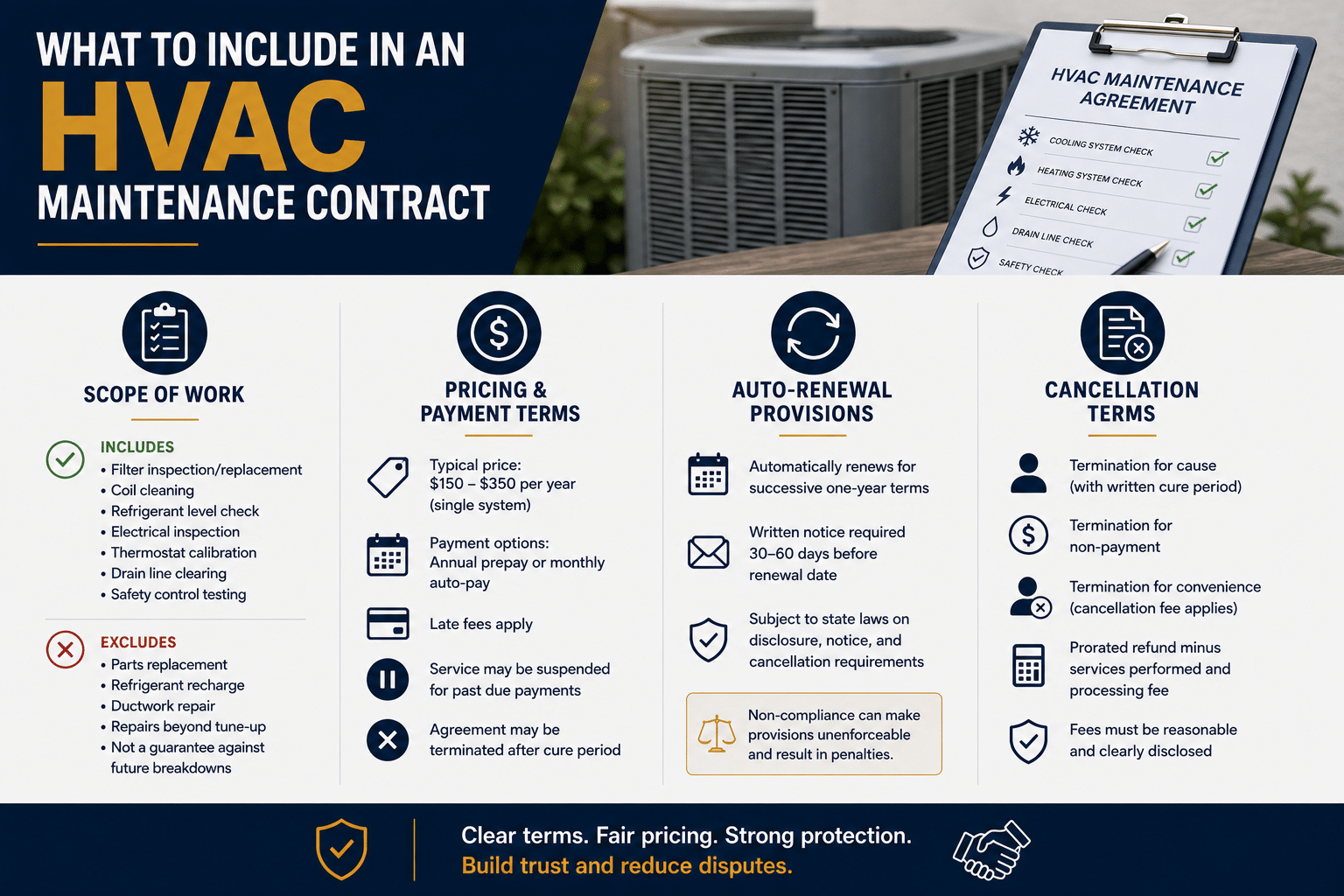
For a standard residential maintenance agreement, the scope should reference a specific checklist of tasks: filter inspection and replacement (or recommendation), coil cleaning, refrigerant level check, electrical connection inspection, thermostat calibration, drain line clearing, and safety control testing. Attaching the checklist as an exhibit to the contract eliminates ambiguity.
Clearly exclude services that are not part of the maintenance visit: parts replacement, refrigerant recharge, ductwork repair, and any repairs beyond the scope of the tune-up. State explicitly that the maintenance visit is not a comprehensive system inspection or a guarantee against future breakdowns. This single sentence prevents the most common maintenance contract dispute: the customer who claims the technician “should have caught” a problem that caused a failure two months later.
For commercial maintenance contracts, the scope is more detailed. Define response time commitments, after-hours availability, which equipment is covered (by make, model, and serial number), and the process for handling issues discovered during the visit. Commercial customers expect service level agreements with defined performance standards, and your contract should deliver on those expectations while protecting you from open-ended obligations.
Pricing and Payment Terms
Define the contract price, the payment schedule, and the consequences of late payment. Most residential maintenance agreements are priced between $150 and $350 per year for a single system, with discounts for multi-system coverage.
Payment structures vary. Annual prepayment gives you the cash up front but can create refund obligations if the customer cancels mid-term. Monthly billing through auto-pay spreads the revenue but improves retention because customers are less likely to actively cancel a recurring charge than to not renew an annual contract.
Your payment terms should include a specific late fee, the right to suspend service after a defined number of days past due, and the right to terminate the agreement after a specified cure period. For commercial accounts using net 30 terms, include the right to charge interest on past-due balances and to file a mechanic’s lien for unpaid work on real property where your state’s lien statutes allow it.
Auto-Renewal Provisions
An auto-renewal clause is one of the most effective tools for building retention in your maintenance program. The clause automatically renews the agreement for successive one-year terms unless either party provides written notice within a defined window, typically 30 to 60 days before the renewal date.
However, auto-renewal clauses are regulated in many states. California, New York, Illinois, Virginia, and several others have specific requirements for auto-renewal disclosure, notice formatting, and cancellation procedures. Failure to comply with these requirements can render the provision unenforceable and may result in penalties. Have your attorney review your auto-renewal language against the requirements of every state where you operate.
Cancellation Terms
Define the conditions under which either party can terminate before the end of the term. Standard provisions include termination for cause (material breach with a written cure period), termination for non-payment, and termination for convenience with a defined cancellation fee.
The cancellation fee should be reasonable and clearly disclosed at the time of sale. A common structure is a prorated refund of prepaid amounts minus the retail value of any services already performed and a processing fee. Overly aggressive cancellation penalties can trigger consumer protection issues in some states and damage your reputation through negative reviews.
Legal Provisions That Protect Your Business
Limitation of Liability
A limitation of liability clause caps the total amount you can be held liable for under the agreement. Without this clause, a system failure that causes property damage, business interruption, or other consequential losses could expose you to claims that far exceed the value of the contract.
Standard language caps total liability at the amount paid under the contract during the preceding 12-month period and excludes consequential, incidental, and indirect damages. Some states restrict these clauses in consumer contracts, so your language must be drafted with state-specific law in mind.
Indemnification
A mutual indemnification clause ensures that each party is responsible for claims arising from their own negligence. Avoid one-sided provisions that make you responsible for all claims regardless of fault. For commercial contracts, resist customer attempts to include broad indemnification that covers their own negligence, as your insurance does not cover claims arising from the customer’s failure to maintain their premises.
Warranty Language
Define exactly what warranties you provide and for how long. A standard structure includes a 30 to 90 day labor warranty on any repairs performed during the maintenance visit, with a pass-through of the manufacturer’s warranty on any parts installed. Specify what voids the warranty: unauthorized modifications, failure to follow manufacturer maintenance recommendations, and repairs by unlicensed technicians.
Dispute Resolution
Include a dispute resolution clause that specifies how disagreements are handled. A stepped approach (mediation first, then binding arbitration) keeps most disputes out of court while still providing a definitive resolution mechanism. Specify the governing law, venue, and cost allocation for any proceedings.
Residential vs. Commercial Maintenance Contracts
The legal and operational differences between residential and commercial maintenance contracts are significant enough that you should use separate contract templates for each.
- Residential contracts are subject to state consumer protection laws, home improvement contractor statutes, and specific requirements around disclosures, right-to-cancel periods, and auto-renewal notices. The language should be clear and accessible, and the scope should be simple enough that the customer understands exactly what they are paying for.
- Commercial contracts involve more complex negotiations, longer terms, and higher stakes. They typically include service level agreements with response time commitments, multi-system coverage with detailed equipment schedules, asset protection provisions for the building owner, and more detailed indemnification and insurance requirements. Commercial customers will often require you to carry specific insurance minimums and name them as an additional insured on your general liability policy.

Common Mistakes That Cost HVAC Contractors Money
- Using a single generic contract for all customers. A residential maintenance agreement and a commercial service contract have fundamentally different requirements. Using one template for both creates gaps in coverage and enforceability.
- Vague scope language. If your contract says “tune-up” or “maintenance service” without defining what that includes, you are inviting disputes. Attach a specific task checklist to every agreement.
- Ignoring state-specific requirements. Auto-renewal laws, consumer protection statutes, and contractor licensing requirements vary significantly by state. A contract that is enforceable in Texas may not be enforceable in California. If you operate in multiple states, your contracts need state-specific review.
- No cancellation fee structure. Without a defined cancellation provision, customers can cancel mid-term after receiving their first visit and you have no recourse. A reasonable, clearly disclosed cancellation fee protects your economics.
- Failing to update contracts. Laws change, your service offerings evolve, and your insurance requirements shift. Review and update your contract templates at least annually with input from your attorney.
Building a Maintenance Program That Drives Business Value
The most successful HVAC maintenance programs share a few characteristics:
- Tiered offerings. Offer two to three tiers (basic maintenance, priority service with repair discounts, comprehensive coverage with full repair inclusion) so customers can self-select based on their needs and budget. Each tier should have its own contract with clearly defined scope.
- Systematic enrollment. Train your technicians and customer service team to present the maintenance agreement at every service call and installation. The best time to enroll a customer in a maintenance contract is immediately after you have solved their problem and demonstrated your value.
- Retention tracking. Monitor your renewal rate closely. An 80% or higher renewal rate indicates a healthy program. Below 70%, investigate whether the issue is pricing, service quality, or communication.
- Contract compliance. Ensure that your legal documents support your business strategy. Your contracts should make it easy for customers to say yes and stay enrolled, while protecting your margins, limiting your liability, and building the kind of recurring revenue that increases your company’s value over time.
When to Have Your Contracts Reviewed
If your maintenance contracts are based on a template, have not been updated in more than two years, or have never been reviewed by an attorney who understands the HVAC industry, it is time for a review. The cost of a professional contract review is a fraction of what a single dispute can cost.
At Next Era Legal, we serve as fractional general counsel for HVAC companies and home services businesses. We draft, review, and update maintenance contracts, service agreements, and commercial contracts for contractors across the country.
Need your maintenance contracts reviewed or drafted? Schedule a Consultation
Disclaimer
All information is for educational purposes only and does not constitute legal advice or form an attorney-client relationship.