

You have found an HVAC company you want to buy. The financials look strong, the owner seems motivated, and you have signed a letter of intent. Now comes the phase that determines whether this deal creates value or destroys it: due diligence.
HVAC acquisition due diligence is the systematic process of verifying every material claim the seller has made about the business, identifying risks that were not disclosed, and confirming that the company you are buying is actually the company you think you are buying. It is your last opportunity to renegotiate the price, restructure the deal, or walk away before you are legally and financially committed.
This guide provides a comprehensive HVAC due diligence checklist organized by category: financial, legal, operational, workforce, customer, and environmental. Whether you are searching for a due diligence checklist buying a business for the first time or you are a private equity firm executing an add-on acquisition, every item on this list exists because deals have closed without adequate review in that area, and the buyer paid for it.
If you are earlier in the acquisition process, our guide to buying an HVAC business covers the full lifecycle from valuation through closing. This article focuses specifically on what to review once you are under LOI and inside the diligence period.
Financial Due Diligence
Financial due diligence is the foundation of your HVAC business financial due diligence process. Every other category of review ultimately connects back to the numbers. If the financials do not hold up, nothing else matters.
Historical Financial Review
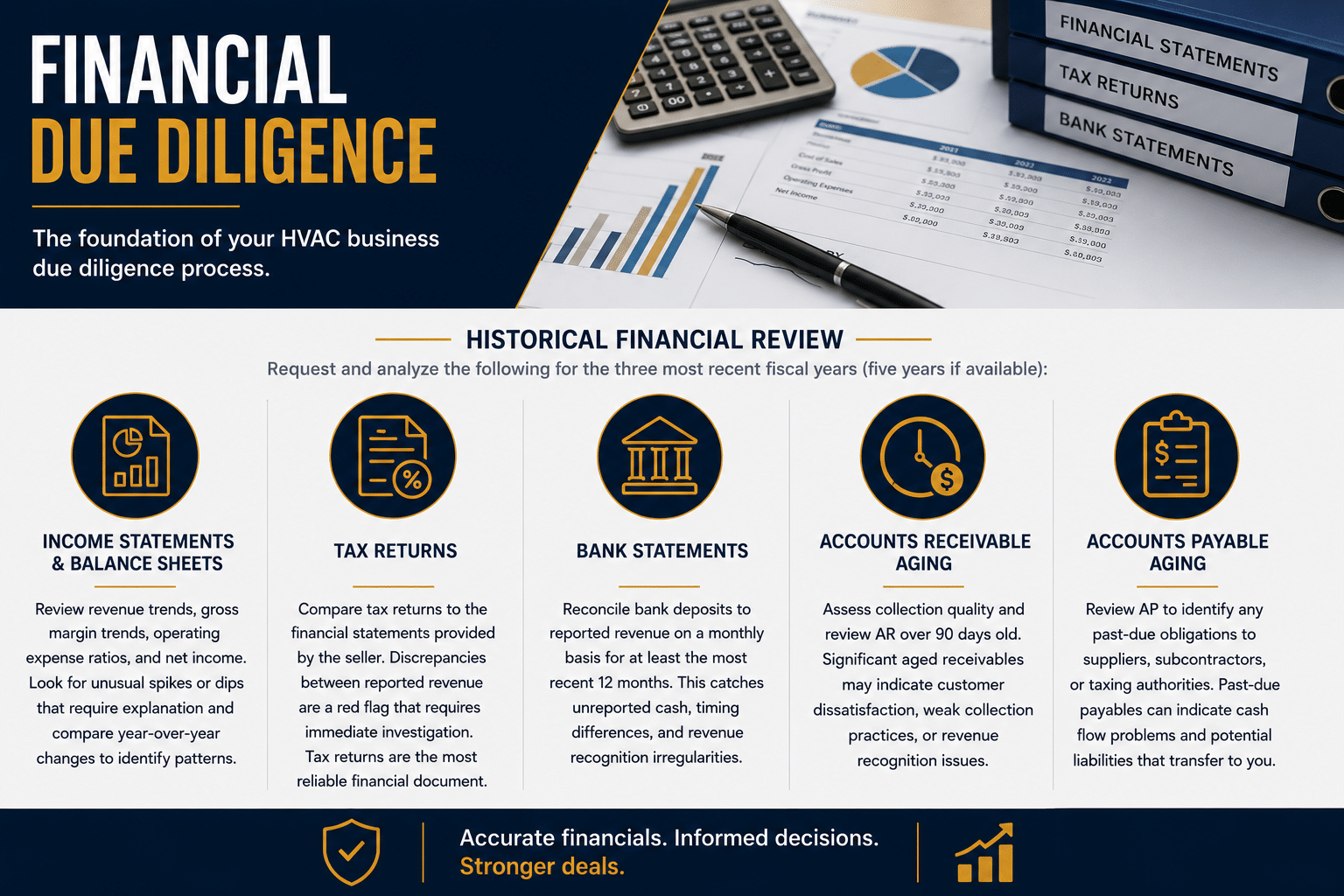
Request and analyze the following for the three most recent fiscal years (five years if available):
- Income statements and balance sheets. Review revenue trends, gross margin trends, operating expense ratios, and net income. Look for unusual spikes or dips that require explanation. Compare year-over-year changes to identify patterns. An HVAC business with declining gross margins may be facing pricing pressure, rising material costs, or a shift in revenue mix from higher-margin service work to lower-margin new construction.
- Tax returns. Compare tax returns to the financial statements provided by the seller. Discrepancies between reported revenue on tax returns and revenue shown on internal financials are a red flag that requires immediate investigation. Tax returns are the most reliable financial document because the seller filed them with the IRS under penalty of perjury.
- Bank statements. Reconcile bank deposits to reported revenue on a monthly basis for at least the most recent 12 months. This step catches unreported cash transactions, timing differences, and revenue recognition irregularities that may not surface in the financial statement review alone.
- Accounts receivable aging. Review the current AR aging report to assess collection quality. AR over 90 days old is at high risk of becoming uncollectible. Significant amounts of aged receivables may indicate customer dissatisfaction, weak collection practices, or revenue recognition issues. Calculate the bad debt rate and compare it to the seller’s historical write-offs.
- Accounts payable aging. Review AP to identify any past-due obligations to suppliers, subcontractors, or taxing authorities. Past-due payables can indicate cash flow problems and may represent liabilities that transfer to you in a stock purchase.
Quality of Earnings Analysis
A quality of earnings HVAC analysis goes beyond the raw financials to normalize the seller’s earnings and assess their sustainability. This is the single most important financial diligence workstream, particularly for PE buyers and in any deal where the purchase price is based on a multiple of earnings.
The QoE analysis should normalize for owner compensation (adding back above-market salary and personal expenses), one-time items (legal settlements, insurance claims, COVID-related revenue swings), non-recurring revenue (large one-time projects that will not repeat), and accounting adjustments (changes in depreciation methods, inventory valuation, or revenue recognition practices).
The QoE should also test the durability of the adjusted earnings by analyzing customer retention rates, pricing trends, and the mix of recurring versus project-based revenue. An HVAC company showing $1.5M in adjusted EBITDA that includes $300K from a one-time commercial installation project has durable earnings closer to $1.2M.
Revenue Quality and Recurring Revenue Analysis
HVAC recurring revenue analysis is where the financial story gets specific to this industry. Break the company’s revenue into distinct categories and analyze each one:
- Maintenance agreement revenue. What percentage of total revenue comes from preventive maintenance contracts? What is the average annual value per agreement? What is the renewal rate? What is the customer retention rate after year one, year two, and year three? Maintenance agreement revenue is the highest-quality revenue stream because it is predictable, recurring, and comes with built-in upsell opportunities for equipment replacement.
- Service and repair revenue. What is the average ticket size? What percentage of service calls convert to additional work? How much of the repair revenue comes from maintenance agreement customers versus one-time callers? Service revenue from agreement customers is more predictable than revenue from one-time calls.
- Equipment installation and replacement revenue. What is the revenue mix between replacement installations (driven by existing customer relationships) and new construction installations (driven by builder relationships and bidding)? Replacement revenue from an existing customer base is more durable than new construction revenue, which is project-based and cyclical.
- New construction revenue. How much of the business depends on new construction projects? Who are the general contractor relationships? Are these relationships documented with contracts, or are they informal? New construction revenue over 40% of total revenue represents concentration risk.
Legal Due Diligence
HVAC business legal due diligence examines every legal relationship, obligation, and exposure the business carries. This is where hidden liabilities surface.
HVAC Contractor License Verification
HVAC contractor license verification is one of the first items to complete because it can be a deal-breaker. Verify the following:
- License status. Confirm that all state and local HVAC contractor licenses are current, in good standing, and free of any disciplinary actions or complaints. Check with the state licensing board directly. Do not rely solely on the seller’s representations.
- License holder. Determine whether the contractor license is held by the business entity or by the owner personally. If the license is in the owner’s name, it does not transfer with the sale. You or a qualifying individual on your team must hold or obtain the appropriate license before or immediately after closing. In some states, there is a transition period; in others, there is not.
- License history. Request the full history of any complaints, investigations, or disciplinary actions related to the license. Even resolved complaints can indicate patterns that affect the company’s reputation and your risk profile.
Contract Review
Review every material contract the business is party to:
- Customer contracts and service agreements. Analyze the terms, pricing, renewal dates, and cancellation provisions for all active maintenance agreements and service contracts. Pay particular attention to HVAC service contract transferability. Many contracts include anti-assignment clauses that require customer consent before the contract can be transferred to a new owner. If a significant portion of the company’s recurring revenue is locked in contracts with anti-assignment provisions, you need a plan to obtain those consents before or immediately after closing.
- Vendor and supplier agreements. Review all supply agreements, equipment dealer agreements, and manufacturer authorization agreements. Identify any minimum purchase commitments, exclusive dealing provisions, or volume-based pricing that may change under new ownership.
- Real property leases. Review the terms of any facility leases, including the remaining term, renewal options, rent escalation provisions, and assignment clauses. Ensure the lease can be assigned to you (or your acquisition entity) without triggering a default.
- Employment agreements. Review all employment contracts, non-compete agreements, non-solicitation agreements, and any bonus or commission structures for key employees. Understand what obligations transfer to you and whether any change-of-control provisions are triggered by the acquisition.
- Subcontractor agreements. Review all subcontractor relationships, including scope, pricing, insurance requirements, and indemnification provisions. Identify any subcontractors who could be reclassified as employees under applicable labor laws.
Litigation and Claims Review
Request a complete history of all litigation, arbitration, administrative proceedings, and threatened claims involving the business for at least the past five years. Review open matters with the seller’s counsel to assess potential exposure. Check court records independently to verify the completeness of the seller’s disclosure.
Common claim types in HVAC businesses include property damage from installations or repairs, workers’ compensation claims, customer complaints filed with licensing boards, and subcontractor payment disputes. The existence of claims is not necessarily a deal-breaker, but undisclosed claims are.
Insurance Review
HVAC business insurance review should cover the company’s full insurance program:
- General liability. Review the policy limits, deductibles, exclusions, and claims history. Confirm that the policy covers the company’s full scope of operations, including any specialized services (commercial refrigeration, clean room HVAC, etc.). Request a five-year loss run from the carrier.
- Workers’ compensation. Review the current policy, the experience modification rate (EMR), and the claims history. A high EMR indicates a pattern of workplace injuries that will increase your insurance costs post-closing. An EMR above 1.2 should trigger additional investigation into the company’s safety practices and incident history.
- Commercial auto. Review coverage, vehicle schedules, and accident history. HVAC companies operate fleets of service vehicles, and auto claims can be significant.
- Professional liability and pollution liability. Depending on the company’s service profile, specialized policies may be required. Companies handling refrigerants, working in regulated environments, or performing design-build work may need coverage beyond a standard general liability policy.
Operational Due Diligence
Operational due diligence assesses whether the business can continue to perform at its current level under new ownership.
Fleet and Equipment Inspection
HVAC fleet inspection acquisition review should include a physical inspection of every vehicle and major piece of equipment. For each vehicle, document the year, make, model, mileage, condition, and any deferred maintenance. Obtain maintenance records for the fleet. A fleet with an average vehicle age over five years will require significant capital expenditure in the near term, which should be factored into your valuation.
Review the company’s diagnostic equipment, recovery machines, brazing equipment, and other tools. Verify that gauges, meters, and recovery equipment are current on calibration and certification. Outdated or poorly maintained equipment affects service quality and technician productivity.
Technology and Systems
Review the company’s technology stack: dispatching and scheduling software, CRM, accounting system, GPS fleet tracking, customer communication tools, and any proprietary systems. Determine whether software licenses are transferable and whether any technology dependencies create risk. A company running its operations on a legacy system that is no longer supported represents both an operational risk and a near-term technology investment.
Inventory
Conduct a physical inventory count and reconcile it to the company’s inventory records. Identify obsolete parts (for discontinued equipment lines), slow-moving inventory, and any items with limited shelf life. Inventory that has been on the books for more than 12 months should be evaluated for write-down.
Workforce Due Diligence
In an HVAC business, the workforce is the product. HVAC technician retention due diligence is one of the most critical areas of review because the company’s ability to serve customers depends entirely on the people who show up in the truck.
Technician Assessment
- Certifications and licensing. Verify that all technicians hold current EPA 608 certifications (the appropriate type for the work they perform), state-specific trade licenses, and any manufacturer certifications relevant to the equipment brands the company services. Identify any technicians whose certifications are expired or who are operating under provisional or temporary licenses.
- Tenure and turnover. Analyze technician tenure data for the past three years. Calculate the annual turnover rate. High turnover (above 25% annually) signals compensation problems, management issues, or a toxic work environment. All three are expensive to fix.
- Compensation benchmarking. Review compensation packages for all technicians, including base pay, overtime, bonuses, commissions, benefits, and any informal perks. Compare to market rates. If the seller has been underpaying technicians relative to market, you face a retention risk post-closing. If the seller has been overpaying, your margins may benefit from natural attrition, but you should understand why above-market compensation was necessary.
- Key person risk. Identify any technicians whose departure would materially impact the business. This includes the lead technician, anyone who holds the qualifying contractor license, and anyone with unique customer relationships or specialized technical skills. For these individuals, consider retention agreements or stay bonuses as part of the acquisition structure.
Management Team
Evaluate the depth and capability of the management team beyond the owner. If the owner is the dispatcher, the estimator, and the primary customer contact, the business has significant owner dependence risk. Determine whether existing managers can step into expanded roles post-closing, or whether you will need to hire additional management capacity.
Customer Due Diligence
Customer Concentration Risk
HVAC customer concentration risk is one of the most important valuation factors and one of the most common reasons buyers renegotiate purchase prices during diligence. Analyze the company’s revenue by customer for the most recent fiscal year:
- Top 10 customer analysis. If the top 10 customers represent more than 35% of total revenue, or if any single customer represents more than 15%, you have a concentration problem. The departure of a single large customer post-closing could materially impact your returns.
- Customer tenure. Analyze how long the top 20 customers have been with the company. Long-tenured customers (five or more years) represent more durable revenue than recent acquisitions. High customer turnover, even with stable revenue, suggests the company is continuously replacing lost customers, which is more expensive and less predictable than retaining existing ones.
- Customer satisfaction. Review customer complaint records, online reviews, and any customer satisfaction survey data. Speak with a sample of key customers (with the seller’s permission) to assess their satisfaction and their likelihood of continuing the relationship under new ownership.
- Contract dependency. Determine how much revenue is secured by written contracts versus how much is based on informal, at-will relationships. Revenue backed by multi-year contracts with defined pricing is more durable than revenue from customers who can leave at any time with no notice or penalty.

Environmental Due Diligence
Environmental issues in HVAC acquisitions are often overlooked by first-time buyers but can create significant liability exposure.
Refrigerant Compliance
HVAC EPA compliance acquisition review should verify that the company complies with all EPA Section 608 regulations regarding refrigerant handling:
- Refrigerant tracking records. Review purchase, recovery, and disposal records for all regulated refrigerants. The EPA requires detailed tracking of refrigerant quantities. Incomplete or missing records suggest compliance gaps that could result in fines.
- Recovery equipment certification. Verify that all refrigerant recovery equipment meets EPA certification requirements and has been properly maintained.
- Phase-out compliance. Confirm that the company is compliant with current and upcoming refrigerant phase-outs (the R-22 phase-out is complete, and HFC phase-downs under the AIM Act are now in effect). Companies still holding significant R-22 inventory or servicing a large installed base of R-22 equipment face transition costs.
HVAC Business Environmental Liability
Beyond refrigerant compliance, HVAC business environmental liability can arise from several sources:
- Used oil and hazardous waste. Companies that service oil-fired heating equipment or maintain large commercial systems may generate used oil or other hazardous waste. Verify that disposal practices comply with federal and state environmental regulations.
- Asbestos exposure. Technicians working on older commercial buildings may encounter asbestos-containing materials. Review the company’s asbestos awareness training records and any documented exposure incidents. Workers’ compensation claims related to asbestos exposure can surface years after the original exposure.
- Underground storage tanks. If the company owns property with underground fuel storage tanks (for fleet fueling), environmental site assessments may be warranted.
Deal Structure and Its Impact on Due Diligence
Your HVAC deal structure asset vs stock decision directly affects the scope and focus of your due diligence.
In an asset purchase, you select which assets to acquire and which liabilities to assume. Your diligence can focus more narrowly on the specific assets being transferred (contracts, equipment, customer lists, trade name) because liabilities that are not assumed generally remain with the seller. However, you still need to verify that the assets are free of liens, that contracts are assignable, and that there are no successor liability risks under state law.
In a stock purchase, you acquire the entire entity, including all of its liabilities, known and unknown. This requires more comprehensive diligence across every category because you inherit everything: pending litigation, tax obligations, environmental liabilities, warranty obligations, and any undisclosed liabilities that surface post-closing. The benefit of a stock purchase is that contracts, licenses, and permits generally continue without assignment, which can simplify the transition. Your attorney should help you evaluate which structure provides the best combination of legal protection and operational continuity.
Private Equity HVAC Due Diligence: Additional Considerations
Private equity HVAC due diligence involves all of the categories above, plus additional areas of analysis driven by the PE investment thesis.
- Platform vs. add-on assessment. Is this company being acquired as a platform (the foundation for a roll-up strategy) or as an add-on to an existing platform? Platform acquisitions require deeper management assessment, technology evaluation, and scalability analysis. Add-on acquisitions focus more on integration synergies, geographic overlap, and customer base complementarity.
- Integration planning. PE buyers should begin integration planning during diligence, not after closing. Identify technology systems that will need to be migrated, accounting practices that will need to be standardized, and operational processes that will need to be aligned with the existing platform.
- Management retention. PE acquisitions typically include management retention packages (stay bonuses, equity rollovers, or employment agreements) for key personnel. The terms of these arrangements should be negotiated during diligence so they are ready for execution at closing. Fractional general counsel for PE portfolio companies can provide ongoing legal support through both the acquisition and the post-closing integration period.
- Quality of earnings scope. PE firms typically commission a third-party QoE report from an independent accounting firm. The QoE scope for HVAC acquisitions should include detailed revenue quality testing (maintenance agreement analysis, customer cohort analysis, seasonal adjustment) and working capital analysis in addition to standard earnings normalization.
HVAC Acquisition Risk Factors: Red Flags and Deal-Breakers
Not every issue discovered during due diligence is a deal-breaker, but some findings should cause you to seriously reconsider the transaction or renegotiate material terms:
- Undisclosed liabilities. Any significant liability that was not disclosed prior to the LOI is a red flag about the seller’s candor and raises questions about what else may not have been disclosed.
- Contractor license issues. If the license is held personally by the owner and there is no clear path to transfer or replacement, the business may not be operable post-closing.
- Customer concentration above 50%. Revenue dependence on a small number of customers creates risk that cannot be easily mitigated through contract terms.
- Technician flight risk. If the lead technicians have no employment agreements, no non-competes, and have expressed concerns about the acquisition, you may lose the workforce you are paying to acquire.
- Environmental non-compliance. Active EPA violations or a history of refrigerant handling infractions create both regulatory risk and potential remediation costs.
- Declining maintenance agreements. A shrinking agreement base signals a customer retention problem that will continue post-closing.
- Significant deferred maintenance on fleet and equipment. A fleet of high-mileage vehicles with deferred maintenance represents a capital expenditure that should be reflected in the purchase price.
These findings do not necessarily kill the deal, but they should result in purchase price adjustments, enhanced representations and warranties in the purchase agreement, increased escrow holdbacks, or specific indemnification provisions.
When You Need Legal Counsel for HVAC Due Diligence
Due diligence is where your attorney earns their fee. The cost of missing a material issue during diligence is measured in multiples of what you pay for legal review. An experienced HVAC acquisition attorney should be involved in:
- Structuring the diligence process to ensure comprehensive review within the timeframe allowed under the LOI
- Reviewing all material contracts for assignability, change-of-control provisions, and unfavorable terms
- Evaluating regulatory compliance including licensing, EPA compliance, OSHA history, and state-specific contractor requirements
- Negotiating purchase agreement protections including representations, warranties, indemnification, escrow, and survival periods based on diligence findings
- Advising on deal structure to optimize the balance between tax efficiency, liability protection, and operational continuity
At Next Era Legal, we serve as fractional general counsel for home services companies and their acquirers. We have guided buyers through HVAC acquisitions ranging from single-location residential operators to multi-state commercial platforms. Our role is to make sure that the business you close on is the business you agreed to buy.
Planning an HVAC acquisition? Schedule a Consultation
Frequently Asked Questions
What to look for when buying HVAC company?
The question of what to look for when buying HVAC company comes up in every acquisition. The most critical areas to evaluate are financial performance (revenue trends, margin stability, quality of earnings), workforce quality (technician certifications, retention rates, key person risk), customer concentration (no single customer over 15% of revenue), recurring revenue from maintenance agreements, contractor license transferability, fleet and equipment condition, and regulatory compliance (EPA, OSHA, state licensing). A buying an HVAC business checklist should cover all of these categories systematically.
How long does HVAC due diligence take?
Due diligence for an HVAC acquisition typically takes 45 to 90 days, depending on the size and complexity of the business. Smaller transactions (under $1M) with clean financials and simple operations can be completed in 30 to 45 days. Larger transactions or PE platform acquisitions may require 60 to 120 days to complete financial, legal, operational, and environmental review. The timeline specified in your LOI should reflect the realistic scope of work required.
What is a quality of earnings report and do I need one?
A quality of earnings report normalizes the seller’s financials by adjusting for owner compensation, one-time items, non-recurring revenue, and accounting irregularities to determine the true, sustainable earnings of the business. Any buyer paying a multiple-based purchase price should commission a QoE. For acquisitions under $500K, a less formal financial analysis may suffice, but for any deal above that threshold, the QoE is the standard of practice.
What are the biggest risks in an HVAC acquisition?
The most common HVAC acquisition risk factors are customer concentration (losing a major customer post-closing), technician flight (losing key employees who were not retained through agreements), contractor license issues (the license does not transfer with the sale), undisclosed liabilities (environmental, legal, or tax obligations the seller did not disclose), and overstated earnings (revenue or profitability that was inflated through accounting practices or one-time items).
Should I do an asset purchase or stock purchase for an HVAC acquisition?
Most HVAC acquisitions are structured as asset purchases because they give the buyer a stepped-up tax basis and the ability to select which liabilities to assume. Stock purchases are sometimes preferred when the company holds contracts or licenses that are difficult to assign, or when the buyer wants to maintain continuity of the business entity. The choice has significant tax and liability implications that should be evaluated with your attorney and CPA based on the specific facts of each deal.
How does private equity approach HVAC due diligence differently?
Private equity firms conduct more rigorous due diligence than individual buyers, typically including a third-party quality of earnings report, detailed customer cohort analysis, management assessment interviews, integration planning, and technology systems evaluation. PE firms also focus on scalability: whether the company can serve as a platform for additional acquisitions and whether the management team can operate independently under a PE ownership structure. The entity structuring for PE acquisitions is also more complex, often involving holding companies, operating entities, and management equity vehicles.
Disclaimer
All information is for educational purposes only and does not constitute legal advice or form an attorney-client relationship.